
Of Mirrors, of Stones
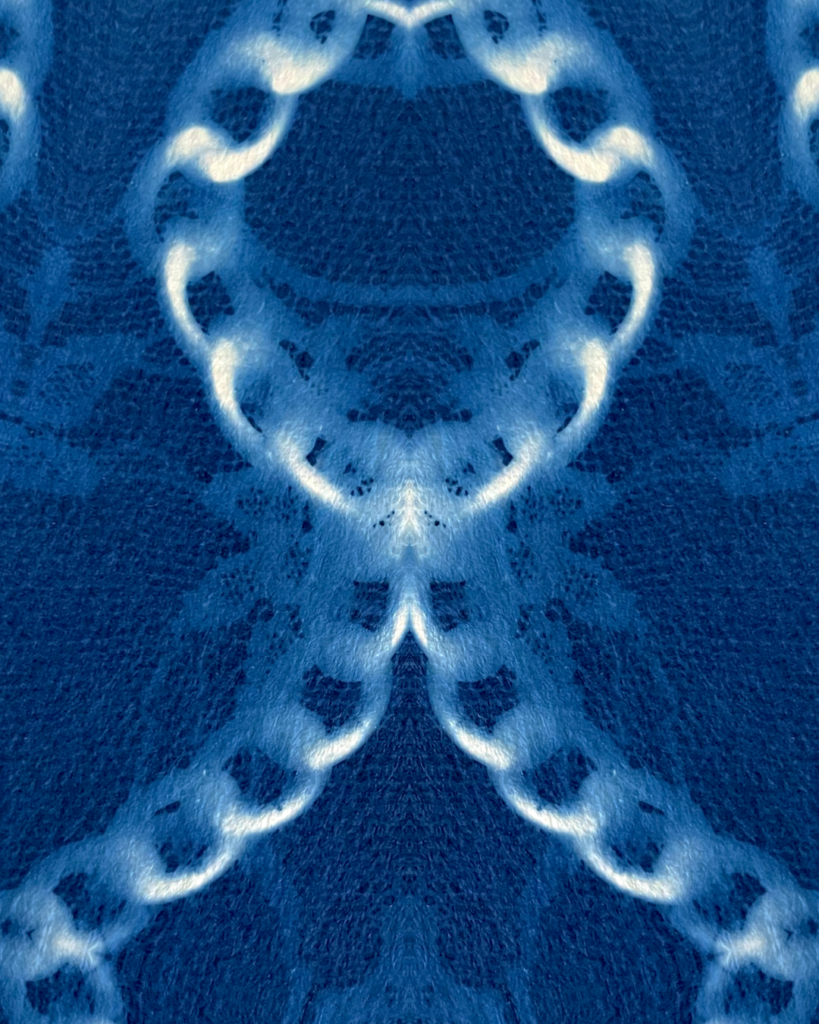
Holly Zhou, “Chains and Lace,” 2026, cyanotype on cardstock.
we throw a stone in the mirror / it bounces back
—Ivan de Monbrison
In 1835, German chemist Justus von Liebig developed a formula for making mirrors with silvered glass, turning the bespoke vessels once reserved for the wealthy into a mass-manufactured household fixture. No longer did a mirror’s reflection hold the numinous—only light waves bounced off a smooth pane of glass and metal coating.
*
The dressing room of my childhood holds a poem I will not write until I am twenty. I stone myself until I warp into the back of the glass.
*
In what he aptly called the “mirror stage,” Jacques Lacan theorized that the self—the “I”—emerges when the infant recognizes itself in an external body, usually that of a primary caregiver or its own image in a mirror. This moment of self-objectification initiates the child’s first understanding of itself in contrast to everything else: from a state of holistic oneness to a state of being one individual among many others.
*
The dressing room of my childhood holds a poem I will not write until I find myself sitting in the bedroom of my first dorm room, holding each palm beneath a tit—two letter scales weighing a package—and wondering if I’m an evil person to imagine a hospital panicking when the 3D mammography won’t let up.
*
Somehow both chemist and psychoanalyst, French poet Ivan de Monbrison probes these theories in his limited-run chapbook The Other Self and asks: What self is damaged with the introduction of this “I” self? Could it be that once the world is split in two, being, too, is denaturalized?
*
The dressing room of my childhood holds some girl, a girl I don’t know until I find her writing. When I go to read what she’s written, she throws a stone through my forehead. It reads:
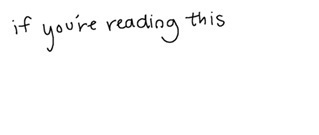
It appears I caught her too soon. Maybe it is time that I stop using “I.” Note to self: write a poem asking what that pronoun might be.
*
In July 2023, I visited Sigmund Freud’s apartment at Berggasse 19, 1090 Vienna, Austria. There’s really nothing like looking into one of the mirrors that Freud certainly used at the site of his psychoanalytic practice, especially since these mirrors also saw him living his private life for forty-seven years. I don’t care for Freud, but I do like his mirrors.
*
To Other the Self, v.:
- To throw a stone at the mirror and have it hit you right back.
- To stone the self.
- To mirror the hitting that you can see, right?
- To be a stone’s throw away.
- To visit the poem living in the dressing room of your childhood and remember why you shop online.
*
Some days, I wonder if writing a poem is a rage against the mirror stage. My family says that a toddler thought my baby eyes were so blue that they tried to poke them out. I think he just saw himself and was trying to pull him out.
*
Jericho Brown says “a poem is a gesture toward home.” I wonder if you (yes, you) think that the stone is the poem, the mirror the home. Does that make me the gesture?
*
Being a poem is like being a bathroom mirror. Everybody tries to look through you, but all they really want to see is themselves.
*
Mary Ruefle’s “Provenance” ends with the following stanza:
I hated childhood
I hate adulthood
And I love being alive
I carry these words with me, even though I’m still working on that last line.
*
The dressing room of my childhood holds a poem I will not write.
*
Dear you (yes, the same you), if you find yourself caught in a mirror, I suggest that you do one of the following:
- Resign yourself to the mirror realm and live with the self you so desperately Othered in an attempt to figure out how to survive. I promise, it will forgive you and help you write a poem. Title it together, and take turns exquisiting your corpse back together.
- Find your Other self and beg forgiveness. That gesture, as Brown says, is a poem. If you need to find a home, delegate the tasks and invite the self you Othered to take the master bedroom. Change the name to just bedroom.
- Wait until someone finds themself in your mirror. Wait until that someone takes a hot shower. In the steam, write yourself into sonnets until you double the alphabet.
*
Today, the dressing room of my childhood holds me like I hold a poem: open, willing, ready to transliterate its sound into a language.
*
Today, I hold myselves, both selves, Jill and Ian.
*
Today, We “I” until the mirror’s silver wrests itself from the glass, settles into Our new body.
Today, We stone the mirror with flatback Swarovski.
Today, We read TC Tolbert and Remi Recchia.
Today,
We
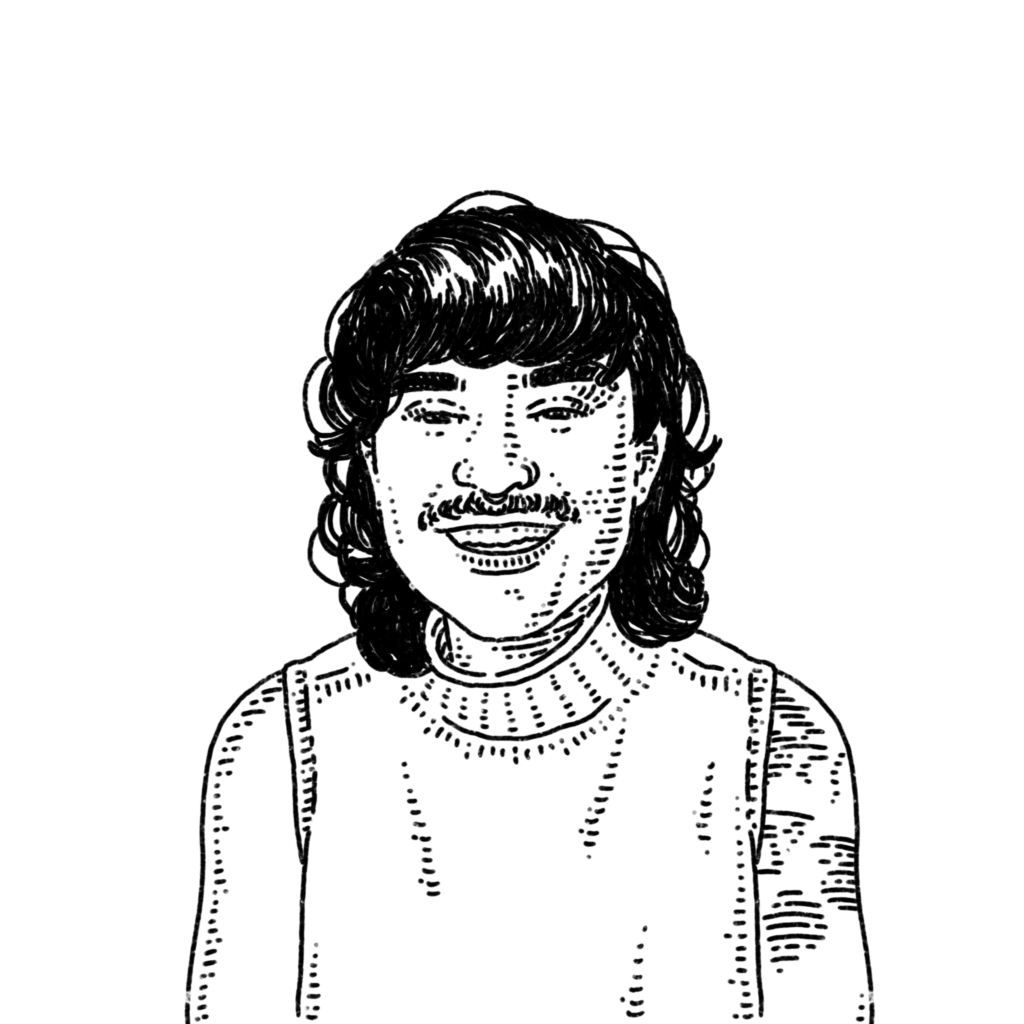
jillIan A. Fantin
Publab Fellow 2026
jillIan A. Fantin (they/them) is a fluxing queer artist with roots in the American South and north central England. They are the vessel of transmission for THE DOUGHNUT WORLD (fifth wheel press, 2024), the transcriber of A Playdough Symposium (Ghost City Press, 2023), and the author of young velvet porcelain boy (kith books, forthcoming). Ian currently lives and teaches in Ohio.

Holly Zhou
Publab Fellow 2026
Holly Zhou is a writer and mixed-media artist from the California desert, the unceded territory of the Cahuilla and Mojave peoples. Working across video, electronics, sound, software, bookbinding, and collage, Holly’s projects curate experiences mediated by play and a poetics of liberation. Their collaborative installations have been exhibited in places such as the New City Arts Gallery, the Field Projects Gallery, and the Ely Center of Contemporary Art. More of their work can be found at hollyz.cc.