
A Corporate Digest

Manuscript illumination from “the Hours of Catherine of Cleves”, (fol. 168v): Master of Catherine of Cleves, circa 1440.
David followed the woman in the navy pantsuit toward a moment six years of school had been pointing to—countless dorm rooms, textbooks, and microwave dinners converging. Her five-inch-high heels led him down a precisely built hallway. It was simple yet thoroughly coordinated. Whoever designed it—whoever chose to have the floor, ceiling, and walls meet the way they did—clearly knew mathematics well. Marked by charcoal walls, bleach-clean floors, and invasive fluorescent lighting, it was impossible to ignore the significant effort taken to make something so well constructed.
The tower it resided in played the same. A gray, concrete, symmetrical building, stiff and simple—all windows perfectly aligned, no extra embellishments—though it dominated any structure it stood next to. To see its top required cocking one’s head back past comfort and squinting through high, foggy clouds.
Only a few months prior, David had received his MBA, and this march down the hallway was his first lead. David found the job listing online, and two days later, he was emailed a number to call. In that brief conversation, David was told to come in the following week for a meeting. An interview, he presumed. He felt persuasive over the phone. Surely, he was liked, and that self-assurance dripped out between his teeth as he lip-synched what they had called him: a perfect fit.
Surely, he was liked, and that self-assurance dripped out between his teeth as he lip-synched what they had called him: a perfect fit.
He was brought to a dead end, a black door with faint whispers of control drifting through its composite interior.
“He’ll let you know when he’s ready,” said the woman.
“Thank you. Should I knock just to let him know—?”
She smiled and turned before he could finish.
David adjusted his overcoat and let the dissipating reverb of clicking heels give him something to hold on to. Once the sound disappeared, the door cracked, a sign to come in; he pushed lightly. David was presented with a minimalist office. Unique in its proportions, the area was no more than 150 square feet—the width and length reasonable—but, in looking up, David found the ceiling to be far too high. As with the tower itself, David had to throw his head back and squint his eyes.
The room was entirely white, though some color did come from a few pieces of furniture. The wooden bookshelves that lined both the right and left sides of the office were maybe 12 feet high but still had a ways to go to reach the ceiling. The books themselves were leather-bound—maroon, navy, and dark green. The spines were blank: no authors, no titles, just color. A square black desk in the center of the room held three items: a notepad, a black pen, and a nameplate, “Ignis F.—Hiring Director.” Behind it was a man gift wrapped in a well-tailored gray suit. His pale skin, plastic and smooth, was the result of substituting Vitamin D for artificial rays. On the back wall, behind the polished man, hung a perfectly framed and centered painting. David had seen the piece before—Saturn Devouring His Son.
“Hello.” Ignis offered a wide, practiced smile, a set of veneers giving his expression the structure it needed.
“Hi, thank you so—”
“Please.” Ignis interrupted calmly, stretching the palm of his hand and using four tight fingers to point out a chair in front of his desk. “Sit.”
“Right, well I just wanted to say thank you for—”
“Ignis.” He offered his hand across the table, a choreographed gesture.
“Hi—David—great to meet you.” They shook hands.
“How are you?” Ignis said, smiling still.
“I’m good, so excited for the opportunity.”
Ignis stared with the plastic smile still on his face. Like the hallway, like the woman in the navy pantsuit, like the office—it was consistent, the same each time, as though it were practiced.
“Well.” David waited for a move but none was made. “I could tell you about my experience. I just graduated. I’m sure you saw my résumé.”
“Oh, David. That will not be necessary. Frankly,” Ignis leaned in and aired his voice to a whisper, “this is not an interview. A meeting like this means you are already hired.”
Ignis leaned back and returned his voice to normal. “We just want to know if you’ll take it.”
“Really! I—I—” David stood with an enthusiasm that reached itself over the table to shake Ignis’s hand again. “Thank you so much!”
Ignis’s smile initially met David’s excitement, until he saw David’s open palm. Ignis leaned back with concerned surprise, his eyes wide and raised, riddled with fear. He wasn’t prepared for the gesture and had no idea how to tackle it.
“Oh, uh, sorry.” David sat back down. “But, of course—I’d love to take it!” Ignis’s smile returned, his eyes relaxed. “Oh, but I do have one question—I don’t want to seem unprofessional or anything—but what specifically is the title of the position? ’Cause on the listing it just says business administration. Is that an assistant or a coordinator?”
“Oh, no, no. Your formal title is Business Overfuel Collector, but informally, think of yourself as waste management. You will make sure it runs clean.”
“It? What exactly—”
“That’s a wonderful question! Really, it would be easiest if I just showed you to your workstation—give you an idea of what it is you’ll be working with.”
“Sure! That sounds great.”
David stood up and began a motion toward the door.
“Please,” Ignis said sharply. “Just stand right there.” He walked from behind his desk and positioned himself to the right of David.
“I thought we were going to my desk?”
“Please face me,” he said. “Just relax and proceed when you’re ready.”
Ignis stood motionless, staring through David.
From inside Ignis’s chilled plastic skin, David heard a soft popping, evolving into cracks and contortions of the jaw. He could see lower bones disconnecting from upper ones, small shifts in Ignis’s mouth turning into inhuman torques and jerks. His lower jaw began to descend, dropping toward the floor, widening as it slowly fell.
David didn’t want to be rude. The last thing he expected was a new form of the human body, which was, admittedly, out of his scope, something he hadn’t prepared for. But truly, he didn’t want to be rude. His discomfort could break barriers of professionalism. Ignis saw the uneasiness growing throughout David. He paused, his jaw dislocated and swinging.
The last thing he expected was a new form of the human body, which was, admittedly, out of his scope, something he hadn’t prepared for.
“David.” His voice gurgled and came out airy, his lips too far apart to make anything sound whole. “You seem … unsure.”
“I’m sorry, but, well, I suppose I didn’t expect—” He didn’t want to point, so he glanced to the side and nodded his head forward a bit. “This.”
“Well, I can assure you it’s normal. This is how we do things here.”
“I’m just … I suppose it is a bit of a surprise.”
“Well,” gurgles and spit flew with Ignis’s words, “your response is not unusual. This job can take getting accustomed to. But you still want it, don’t you?”
“Yes, of course.” David was worried he’d let his concern fumble an opportunity. “I’m sorry—please, don’t worry about me. Continue.”
“Are you sure? It’s not too late to back out.”
David nodded.
Ignis resumed, his cheeks growing even further apart, his jaw dropping lower. The veneers popped off, hit the office door, and went stumbling across the floor. A gaping hole came into existence. As Ignis’s chin reached his high-shine calfskin shoes, his eyes rolled to white and his tongue unfurled from the back of his throat until it met the tips of David’s feet. It was like the skin of an alligator and wider than before, 10 times so. The air in the room had become heavy, a note of decay leading to what David assumed was Ignis’s breath.
“Ignis?” David asked, but there was no response.
David looked up and down the gaping mouth and rigid, scaled tongue. “So this is it?” Maybe this job just wasn’t the right fit. It was visceral, intimate, and David always had trouble with those types of relationships. But the world he was in had evolved into a competitive machine; it wasn’t afraid to bite hard, chew a few times, and spit you back out. That meant that an opportunity like this really was once in a lifetime.
He stepped forward, placing his foot onto Ignis’s tongue. Taste buds texturized the dewy surface molding itself to the bottom of his shoe. It was a new sensation, uniquely soft, comforting. The way it sank like a memory foam mattress under David’s weight, holding a lasting impression—a yearning. He was wanted.
Proceeding step-by-step to the lips, David confronted the opening of something magnificent. As he approached, he heard a sizzle on the bottom of his shoe. Lifting his foot, David saw a brand on the rubber sole in vague, small writing: words that could only be read by eyes a few inches away. He put his foot back down and moved through the lips, touching his hands to the inside of Ignis’s elastic cheek as he passed.
Proceeding step-by-step to the lips, David confronted the opening of something magnificent.
Going further into the mouth, he dropped into a stomach crawl, shimmying himself deeper as the space thinned. Further into the esophagus, inner linings hugged his body, the walls covered in a congealed liquid. David gagged a couple times, but he shook his head and kept on—professionalism. The sticky walls slowed him down, ensuring he wouldn’t slip all the way through the digestive tract. As he descended, he started to hear a low, humming thud. It was the heart. The beats were slow, maintained, consistent.
Slowly sliding down the esophagus, he came face-to-face with a pair of rubber soles—soles attached to legs, attached to the body of a co-worker lying, as David was now, in the slimy darkness. “Hey!” David tried calling out to him. “You there?”
“W—t, i– so—o–e be–i–d –e? I c–n’t –ear any—ng.” The voice was too quiet. David could only make out segments of words.
“What? I can’t hear you, you’re too quiet!” But to this, the person in front of him made no effort at communication. David fixed his eyes onto the soles. Like his own, they had been marked, branded:
INSTRUCTIONS: Massage in fluid as it emerges from the surface. You will be promoted and may move along your career path once the individual in front of you has advanced further.
The fluid was bubbling up from tiny pores. Feeling it surface, David exhaled a heavy breath. So this is it? He had spent so much of his life preparing for a job that could bleed into a career, but now, the position he had sought after so desperately was packaged in emerging piles of mucus. David tried to console himself with his own purpose: at least he had a role to play, and in this world, those were rare. He was lucky. David’s only path to something better, a more important role, was to perform the one he had, and perform it well. As he was told, and still firmly believed, he was a perfect fit—this job was made for him, and he for it.
He was lucky. David’s only path to something better, a more important role, was to perform the one he had, and perform it well.
He paused for a few seconds, just himself, the skin, the hum, the slimy fluid. David closed his eyes, rested his forehead on the thin ground, and let out a sigh. His time was now. This was it. He opened his eyes, raised his head, and began massaging the fluid. Pressing his hands down, David let the thick, squidgy feeling caress his palms and slip through his fingers. It played like putty mixed with Vaseline, holding a light yellow tint. The more David worked, the more he felt the rhythm. The humming heartbeat swayed him, gave him something to grasp on to, something of guidance and comfort.
Mother and son, calf and cow, host and commensal—the longer the beat held David, the more he gave himself to this new world. More than just the heartbeat, David felt a consistent breath run along his skin, waves drifting by. He was becoming one with the space. It didn’t just yearn for him; he yearned for it, his own breath falling into the same rhythm as the air that passed, his heartbeat tuning to the hum of pumping blood.
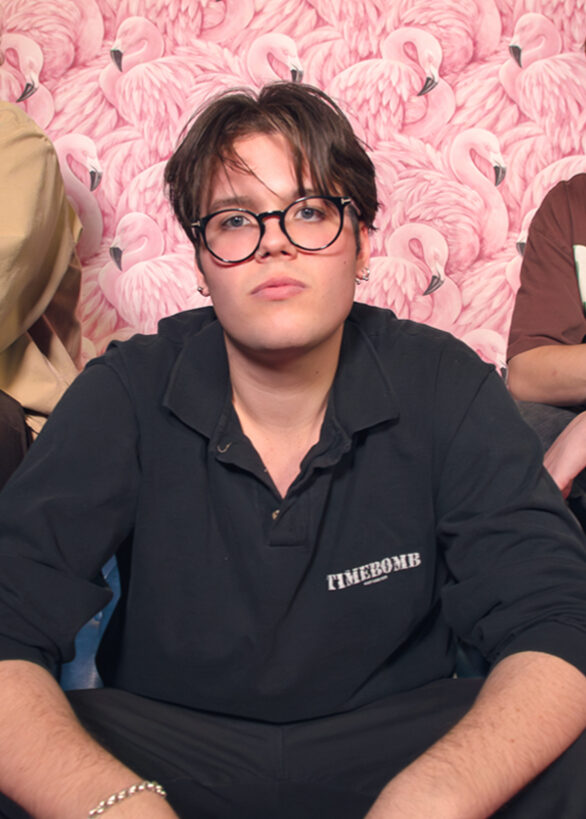
Tye Iverson
Publab Fellow 2026
Tye Iverson is a recent graduate of Pitzer College, where he studied creative writing and philosophy. He was, in many ways, born into horror: he grew up reading Dante’s Inferno as a bedtime story and later inherited his grandmother’s library of gothic literature. That upbringing shows in his fiction—stories that explore performance, identity, and obsession, and that pull their characters into moral and ethical dilemmas they can’t escape. He is relocating to Philadelphia, where he will continue to front his band Sub Mold while building a career in the literary world.