
Anne Boleyn in the Manosphere: What Ava Pickett’s hot new period piece can teach us about misogyny’s past and present
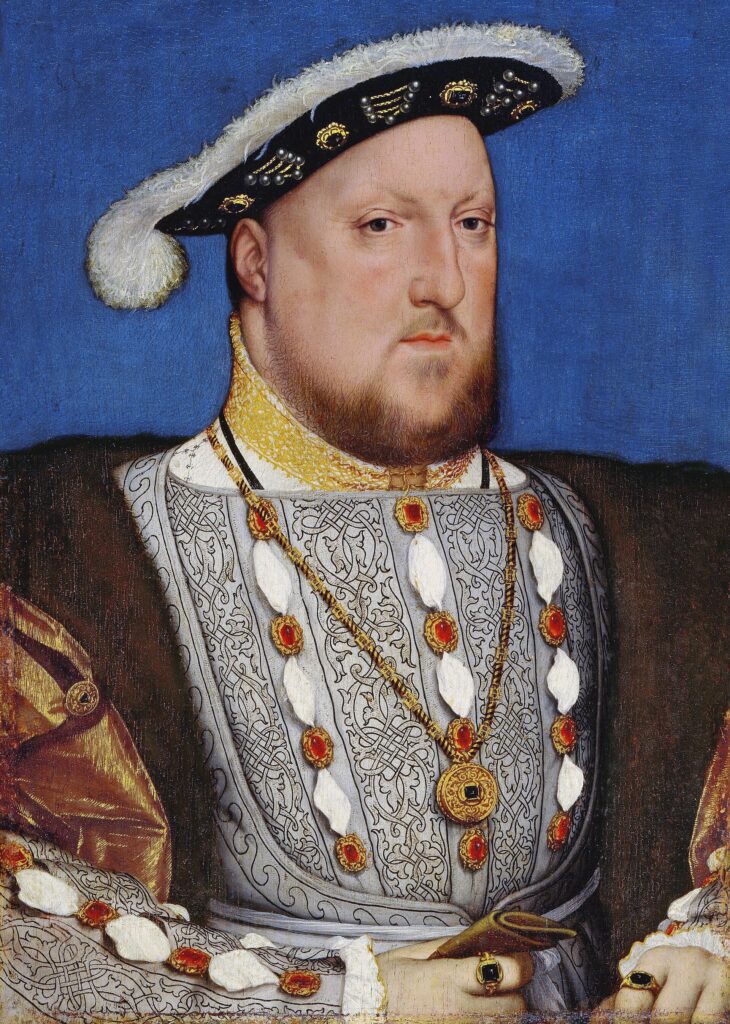
“Portrait of Henry VIII of England” (1537), Hans Holbein the Younger. Courtesy of Museo Thyssen-Bornemisza.

“Portrait of a Woman, inscribed in gold over red ‘Anna Bollein Queen'” (1532-36), Hans Holbein the Younger. Courtesy of the Royal Collection.
On April 26, 2025, just over one week before Ava Pickett’s 1536 premiered for its sold-out run at the Almeida Theatre in London, 38-year-old Owen Lawrence attacked the popular Otley Run pub crawl in Leeds, England, seriously injuring two women. In January of that year, he made a post detailing his hatred of—among other communities and concepts—“feminists of all four waves” and “gender equality.” Lawrence’s assault was just one of a litany of attacks on women and girls in England that seemed to haunt Pickett as she wrote the play. In an interview with Vogue, she lamented the near-constant news cycle of women’s suffering: “There’d be a vigil, there’d be a protest, there’d be a march, an MP would say something about how it must change, but it didn’t.”
Lawrence’s online screed and the violence that followed were likely met with encouragement and praise across the “manosphere,” a spectrum of entangled groups including masculinity influencers, incels, pick-up artists, and predators whose rabidly misogynistic (as well as racist and homophobic) views have been amplified in recent years by social media. But while the platforms available to spread such viewpoints are a twenty-first-century invention, the attitudes themselves are certainly not.
On May 19, 1536, 489 years before the misogyny-fueled terrorist attack at Otley Run, another group of Englishmen accomplished their own kind of terror when Anne Boleyn was executed on spurious charges of adultery, high treason, and incest. Boleyn suffered multiple miscarriages in her unsuccessful attempts to produce a male heir for King Henry VIII, but her persistent and painful efforts did not save her reputation or her life. Henry was betrothed yet again the day after the execution and would go on to have four more wives after Boleyn, including Catherine Howard, who was 17 at the time of her marriage to the 49-year-old king and not yet 20 when he had her executed. After Henry’s death, the crown passed to his only son, Edward VI, who was born to his third wife, Jane Seymour. Edward died childless at age 15, sending the Tudor line into a succession crisis, and rendering Henry’s mad conquest of his wives’ bodies ultimately for naught.
It is impossible to directly link Henry VIII’s treatment of his wives to a quantifiable rise in misogynistic violence in early modern England, but his legacy clearly held on—even 50 years after Boleyn’s execution, men spread rumors claiming that she had a sixth finger and a “Devil’s mark.” Virulently misogynistic writing from the period spread as widely as it does today, even without TikTok to amplify the message. In 1536, Pickett masterfully illuminates the links between the Tudor era’s well-known—and supposedly extinct—brand of misogyny and the current global rise in misogynistic rhetoric emblematized by the manosphere and its vociferous adherents.
Pickett has reported being inspired by “the whispered conversations between women” that she imagines would have taken place as news of Boleyn’s trial and execution filtered out from London and into the homes of everyday English people. In 1536, these events are debated by three women: Mariella, an intelligent and practical midwife; Jane, a timid and conservative bride-to-be; and Anna, a forward-thinking and sexually liberated maidservant. Over the course of the play, the three meet in a bleak, parched field in the Essex countryside to discuss the dramas—both inconsequential and politically momentous—in their lives. One day, the most exciting news might be that Jane saw a frog; the next, the queen is in the Tower on charges of adultery.
In 1536, Pickett masterfully illuminates the links between the Tudor era’s well-known—and supposedly extinct—brand of misogyny and the current global rise in misogynistic rhetoric emblematized by the manosphere and its vociferous adherents.
Slowly but surely, the news begins to resonate with the women’s own experiences in their unassuming village. As Boleyn is interrogated in London, enraging and emboldening men across England who are conditioned to believe that women are inherently untrustworthy, Anna desperately tries to hide that she has been regularly sleeping with Jane’s new husband, Richard. When she hears from Mariella that Jane has been seen in town with a black eye, however, Anna confronts him; enraged by her accusation, he spits, “So you heard about a black eye, a black eye you never saw, and you guessed I’m how she got it? I wouldn’t do that, Anna, if I were you.”
Richard’s words most obviously reflect the king’s authority to invent narratives against his wives to support his agenda—and they also chillingly recall Andrew Tate’s response to reporter Heidi Blake when questioned about the dizzying evidence of his sexual, physical, and psychological abuse of women: “[S]how me a victim,” he demanded. “[S]how me a hurt girl.” Like Tate and Henry VIII, Richard easily denies evidence and evades responsibility. Richard’s implicit threats of violence—and, immediately after, his initiation of sex with a reluctant Anna—also echo Tate, who once recorded himself waving a machete and saying, “Slap, slap, grab, choke. Shut up, bitch. Sex.”
Throughout the play, Pickett’s male characters emulate their king’s behavior, flagrantly committing adultery while disparaging Anna for her sexual “looseness.” Today, thousands of men follow Tate as their own manosphere monarch. In the influencer’s “War Room,” men could pay $8,000 a year to acquire a “PHD”—a “Pimping Hoes Degree.” Should they be interested in more education, Tate also launched “Hustlers University,” where “students” paid $49.99 per month for access to videos in which he suggested that women should be stripped of the right to vote, removed from the workplace, and forced to bear children. In 2022, it was rebranded to “The Real World,” and currently has over 155,000 enrolled members.
Andrew Tate’s response to reporter Heidi Blake when questioned about the dizzying evidence of his sexual, physical, and psychological abuse of women: “[S]how me a victim,” he demanded. “[S]how me a hurt girl.”
As a New York Times profile on Pickett posits, “The men in the play start to seem as if they’ve been listening to manosphere podcasts.” Pickett quickly agrees: “A lot of younger women are experiencing that right now.” Early modern women, too, knew this pain well. The men in 1536, whether they are village bakers or minor gentry, are, after all, enrolled in a Hustlers University of their own. There, they learn to manipulate reality: if they say that Boleyn slept with her own brother, it is true. If they say that their wives have black eyes from falling down the stairs, that is also true. Women’s words can shrink and fade when confronted by the manosphere’s violent, unearned authority.
Nevertheless, words between women still held weight in the play’s setting of Tudor-era Essex, just as they do today. 1536 is keenly interested in women’s whisper networks and the empowerment and safety that they can provide. There is a reason why the word “gossip,” once used to describe close groups of women who supported one another through processes like childbirth and homemaking, became the term for malicious (female) conversation: women’s words, passed around in secret, can frighten men. Just as the resurgence of Tarana Burke’s MeToo movement in 2017 transported women’s whispered words from the private corners of Hollywood into public discourse, Pickett brings the hushed conversations between women out of the forgotten—or unrecorded—pages of history and onto the stage.
But Pickett does not shy away from the fact that protective gossip and noble intentions are not always enough in a society structured to exclude you. In one of the play’s most upsetting scenes, Anna and Mariella unintentionally witness a man they know and trust raping another young woman. A horrified Anna calls out, but Mariella stops her, saying: “He’s already done it.” The very next scene starts with news that the man and his victim are engaged—as would have been common in early modern England, where strict expectations for feminine chastity meant that a woman could be compelled to marry the man who assaulted her. Pickett unflinchingly portrays violence as a shaping force in women’s lives in a harrowing reminder to the characters and audience alike that it can be difficult, even impossible, to resist violence in a society in which your very personhood is up for debate.
Just as the resurgence of Tarana Burke’s MeToo movement in 2017 transported women’s whispered words from the private corners of Hollywood into public discourse, Pickett brings the hushed conversations between women out of the forgotten—or unrecorded—pages of history and onto the stage.
In another of 1536’s several stomach-dropping scenes, Jane, Mariella, and Anna realize that they have been praying for a dead woman: the queen, they hear, was executed three days ago, consigned to an unmarked grave as the news slowly traveled across the countryside. The women, while processing this news, hear noises offstage. Jane, defeated, tells Mariella and Anna, “They’ve kept the pubs open. The men are celebrating.”
Today, such celebrations have moved from the taverns to the internet. Some revelers, like Owen Lawrence, go on to commit atrocities of their own. A man who murdered his ex-girlfriend, her mother, and her sister in July 2024 was found by prosecutors at Cambridge Crown Court to have been inflamed by Andrew Tate’s “violent misogyny.” In 2022, content tagged with #AndrewTate was viewed over 12 billion times on TikTok.
Tate is far from the only source of violent inspiration. Elliot Rodger, who murdered six people in his 2014 misogyny-fueled attack, was dubbed “the founding father of the incel ideology” by the BBC. Rodger (or “Saint Rodger,” as some call him) has posthumously amassed a devoted online fan base, with his views linked to misogynistic terrorism in Roseburg, Oregon (2015, nine killed), Toronto (2018, eleven killed), and Plymouth, England (2021, five killed).
These unfathomable tragedies might leave us to wonder what has changed from 1536 to 2026—and what we can expect in the years to come. The rhetoric of the manosphere has already spread from the radical fringes of the internet into the corridors of power: Donald Trump, himself a prominent misogynist, hosted a dinner at Mar-a-Lago that included white supremacist Nick Fuentes, who once gleefully posted, “Your body, my choice” (and received over 100 million views).
Plays like 1536 and Pickett’s other project, The Manningtree Witches—a play exploring a series of seventeenth-century witch trials that resulted in the deaths of 23 women—elevate the voices of women who find themselves facing horrific violence. Pickett’s next period piece seems appropriately timed, given that a far-right preacher, Noleen Sedra, recently claimed that early modern European witch trials were justified killings of women who performed abortions, and in fact did not go far enough. Pickett offers an urgently necessary narrative to counter these dangerous claims, demonstrating how women and girls throughout history have stood in the face of oppression—even when it cost them their lives.
The rhetoric of the manosphere has already spread from the radical fringes of the internet into the corridors of power.
Following the announcement of the 2024 US presidential election results, Tate triumphantly tweeted, “THE PATRIARCHY IS BACK.” The connections between the sixteenth and twenty-first centuries, revealed by Pickett’s historical lens, rightly suggest that the patriarchy never really left. Even now, a certain famously abusive husband remains a figure of fascination and even delight: you can easily buy a mug, tea towel, or Christmas ornament depicting Henry VIII at many London gift shops.
If the “New Right” is attempting to establish a “new old-fashioned world,” as political theorist Laura K. Field has argued, a piece like 1536 helps us imagine—and prepare for—what turning back the clock of social progress might look like. Pickett does not leave her audience hopeless, but she refuses to look away from reality. 1536 ultimately reveals how the distant past might not be so distant after all. As Pickett skillfully demonstrates, we still have much to learn from the women of history—both those who survived and those who were not so lucky. Perhaps the best way to learn is to listen closely for the whispered conversations that have previously escaped our notice, allowing those voices to echo among our own.

Evelyn Reidy
Publab Fellow 2026
Evelyn Reidy is an academic and playwright who received her PhD in English and creative writing from the University of Roehampton and Shakespeare’s Globe (London). Her creative-critical research interests include the cultural and political lives of non-elite women and girls in the early modern period and how the period is represented in modern-day popular media. In 2025–26, she was an artistic research fellow at the Folger Shakespeare Library working on her next play, More Weight, or I Saw Goody Proctor at the Gift Shop. She has forthcoming articles in Shakespeare Studies and the Journal for Early Modern Cultural Studies.