
Room for Error: On Printmaking and the Limits of the Body
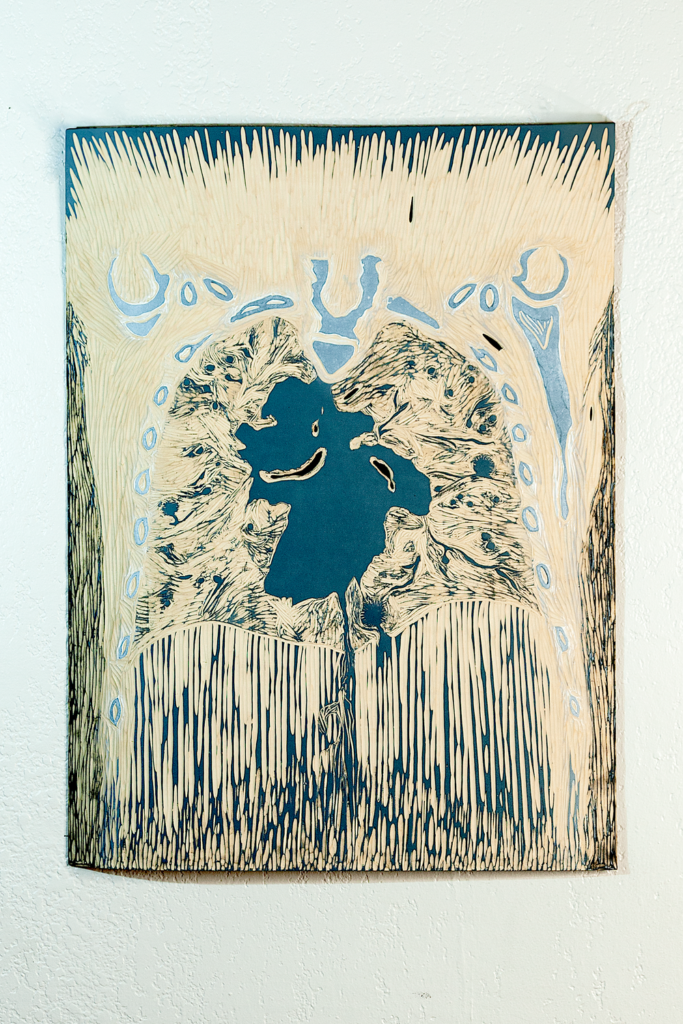
Simone Zapata, Required Transfusion (2025). Courtesy of the artist and the Pappajohn Biomedical Institute, University of Iowa.
At a printmaking studio in Miami, Florida, I lay out dozens of CT scans across my workstation. I’ve enlarged them to a life-size representation of an adult torso, and the pixelated boundary between mass and cavity blurs. I measure the lung nodules, each one unique, and study the contours of their density. A penny, a lentil, a chocolate chip, a mustard seed—their size comparisons are deceptively innocuous. Mustard seeds are harmless; pennies are concerning. Several of these nodules are the size of golf balls.
These CT scans are from 2018, and the body they reference belongs to my aunt Yvonne. They confirmed that her colon cancer had spread beyond the point of intervention. She died six days later.
These CT scans are from 2018, and the body they reference belongs to my aunt Yvonne.
It’s now March 2025, and I’m adapting these CT scans to an 18 × 24 inch block of linoleum to create a series of reduction-cut prints. The reduction-cut technique involves successively carving and printing a single block of linoleum to create a multilayered print. Unlike single-layer or multi-block prints, a reduction-cut print cannot be reproduced—once a layer is carved away, there’s no going back to reprint it. The inability to reproduce a reduction-cut print has earned this method its alternative name of “suicide cut.”
Reduction-cut block prints leave little room for error. As a novice printmaker, I make many mistakes.
I work tirelessly to replicate the shapes and opacities of the scans: Yvonne’s tissue, veins, and bones morphing from one frame to the next. First the ink is too thin, then it’s too thick. The pressure forceful, then muted.
When I look through my pile of test prints, all the proportions are out of whack. The relationship between interiors mutates from screen to sketch, block to print. The veins look like starfish; the nodules like powdered sugar donuts. While carving, I get lost in reverie and my grip slips—
I gouge my thumb and suck out the iron.
Throughout 2017, Yvonne became increasingly ill. Visits to the emergency room for dizziness, nausea, and internal bleeding became so frequent, in fact, that the hospital staff knew her on a first-name basis. Every visit repeated the cycle: the doctors would diagnose Yvonne with severe anemia, give her a blood transfusion, and she’d be on her way.
She hated the hospital—all the poking and prodding, not to mention the delays that come with testing, processing, and clinical handoffs between staff. Yvonne had been living in a nearby trailer park for 20 years, and she often walked home after checking herself out of the hospital.
Yvonne was diagnosed with schizophrenia at the age of 19. Brief stays at a variety of institutions didn’t lead to much. She was on and off medications that sometimes helped, sometimes didn’t. According to many of her hospital consultation reports from 2017, she presented as a “poor historian.”
But she was happy. Her life, as unconventional as it may have seemed to some, was a full one. She married; she held odd jobs to supplement her Social Security income. She spent much of her time tending to her lively pack of six Chihuahuas. She was a private and fiercely independent person.
After a year of repetitive transfusions, Yvonne’s husband, my grandparents, my mother, and I showed up to the hospital to demand further testing. We had to know where all this clean blood kept disappearing to.
Results from a colonoscopy revealed a massive tumor in her colon, and the CT scans confirmed that it had metastasized to her lungs. The rounds of clean blood Yvonne had received were actually feeding this tumor the whole time.
The doctors wanted to keep Yvonne at the hospital for supervision, but we wasted no time deliberating on it—we were getting Yvonne out of there with or without the doctor’s consent. We worked in a silent and seamless choreography to get Yvonne into a wheelchair and out of her room. The hospital floor fell silent as we made our way toward the exit.
That night, my mom and I set up hospice care in Yvonne’s trailer while a home nurse walked us through the end-of-life process. I brought over pancakes from Denny’s, and we made her as comfortable as we could between her favorite foods and a slow drip of morphine.
As I work and rework my adaptation of Yvonne’s CT scans, I’m reminded of bell hooks’s essay “Being the Subject of Art.” In it, she writes, “We do not know the truth that to be seen and not known is the ultimate abandonment. […] To want to know is to transgress.”
In printmaking, no amount of planning or practice yields exactly what you intend. The quality of a print is defined by the artist’s ability to pivot from their slips and listen to what the work has to teach them.
In printmaking, no amount of planning or practice yields exactly what you intend.
After exhaustive iterations of drafting, carving, and printing, my body is reduced to a state of delirium and the block to a pile of scraps.
As I sense the edges of my own physical limitations calcifying around me, it becomes unclear whose body—Yvonne’s or my own—I’m attempting to transgress.
Simone Zapata
Publab Fellow 2026
Simone Zapata is a poet, editor, and educator based in Oakland, California. Her writing can be found in Brink literary journal, Foglifter, Beloit Poetry Journal, Dilettante Army, and elsewhere. Her work has been supported with residencies and fellowships from Hedgebrook, Banff Centre, Community of Writers, and Miami Book Fair. Simone holds an MFA from California Institute of the Arts, and she organizes with the SF/Bay Area chapter of the Editorial Freelancers Association.