
Echoes of the Fourth Person: A Dilemma of Sociality in Electronic Music
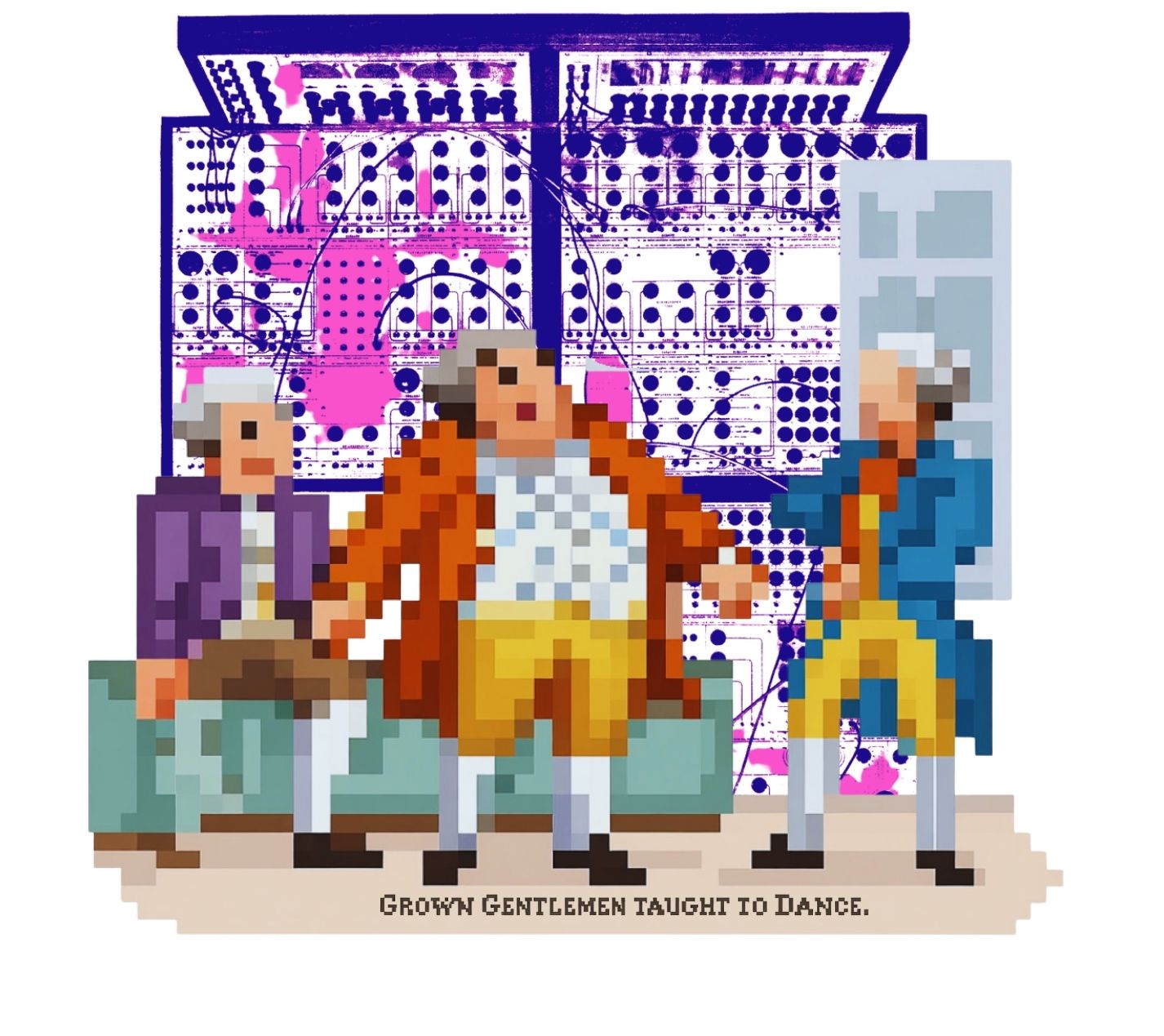
“Taught to dance or so” (2026), digital collage, Sedney Suarez Gordon. Courtesy of the artist. Incorporates images the following: “Grown Gentleman Taught to Dance” (1803), publisher Rudolph Ackermann, courtesy of The Metropolitan Museum of Art; image of the modular electronic music system from https://120years.net/buchla-synthesisersdonald-buchlausa1963/.
ONE PERSON is never enough. Buzzing away on my bassoon in a practice room or listening to The Strokes through a dime-sized speaker lodged in my ear are not typically lauded as the pinnacle of musical experience. One of the platitudes of music is that sound is social: listening together in a concert hall, having a serious post-concert discussion with a stranger, risking a fugitive kiss in the darkness of the dance floor. But these scenes, at least to my cynical eyes, always seem to be tinged with nostalgia; surely this innate sociality has passed us by. Technology is the usual culprit: one can always wax lyrical about the danger of AI music, the proliferation of standardized, uncreative music software, and the widespread use of exploitative streaming services as terrifying milestones toward the complete dissolution of our musically social fabric. Electronic music, from its creation in the studio to its common enjoyment on headphones, seems to be increasingly a solitary affair.
But some responses to this general disruption in music are even more terrifying. The AI lobbyists, as just one representative of the pro-technology camp, have been trying to convince us that these perceived oppressions are actually a method of liberation. We just need to grab a pal, hop on the LLM ark, and survive this biblical flood until some techno-utopia can be reached. The music will be much better anyway, they assure us. Well, if it’s anything like the AI-generated posters I see around my town, I’ll take my chances with God’s wrath.
But even then, I’m not sure if this flood can be survived at all. I worry about the human creativity and collaboration possible with these supposedly liberatory technologies entering the music studio. Due to its heavy reliance on new technologies, electronic music in all its forms—dance, experimental, pop—risks being at the vanguard of a dangerous push for the wide adoption of these catastrophic tools. But this reckless technological optimism has, in fact, been present throughout the history of electronic music. As a musicologist, my humble offering is to recount a short episode in this history as an attempt to build a bulwark against this reckless optimism.
In the bellwether year of 1964, maverick American composer Morton Subotnick declared it so: up until very recently, you needed three people to make music. This “three-person model” included the composer to write the music, the musicians to perform it, and finally some cheery and willing listeners. The galvanizing event for this proclamation was Subotnick’s involvement in the invention of the Buchla synthesizer, one of the first commercially viable electronic synthesizers to use “voltage control” in its design. Influenced by the burgeoning field of cybernetics, voltage control allowed for the automatic adjustment of musical parameters previously relegated to the tinkering of technicians and composers of the electronic music studio. These cutting-edge electronic studios required vast teams of specialists across engineering, physics, and music composition to craft the most elementary of pieces—a far cry even from Subotnick’s lean three-person model. The Buchla’s mandate was to make yet another entry into one of the classic stories of technological innovation: how to replace human labor with automated machines. In other words, how to replace the three-person model.
What this replacement meant for music was—and still is—up for debate. The vogue of late, popular even with AI companies like Palantir, is to stake ontological claims on the fundamental essence of such human-replacing machines. As recent as 2014, composer and radio DJ James Gardner asked Subotnick, “If [the Buchla] produced something unexpected, which you then exploited and incorporated in the piece [Subotnick’s Silver Apples of the Moon], was it acting as a ‘fourth person?’”
Well, shoot—could an inanimate, albeit automated, object be a person? Subotnick retorted:
first of all I knew this machine backwards and forwards before it ever got built because I was in on every detail of it […] So I didn’t get as many ideas from it as you might expect. It was a pretty amazing experience, I have to say—one of the most amazing experiences I ever had—but it wasn’t like surprise after surprise. What I did discover, though, is that it could do things that none of us expected—which is what you asked—but in a different way from what you’re implying, because it didn’t do anything.
It didn’t do anything—well, clearly it did. The Buchla’s revolutionary design could play complex rhythms, mold novel timbres, and operate within subtle tuning systems that would have taken weeks of collaborative work within the old music studios. But the stakes of that innovative “it” which apparently “didn’t do anything” are lucid: was the Buchla synthesizer a collaborator, akin to those old pals in the studio, or was it something else entirely?
This question of whether the Buchla synthesizer was a collaborative “fourth person” in electronic music composition is a tricky one, to be sure. It depends upon one’s criteria of personhood, the stakes of collaboration, and whether the fountainhead of artistic expression is inherently human or not. While many have labored over this dogged question of personhood in the arts, too few have given attention to that something-else-entirely. What kind of interactive tool is overdetermined in its design yet still produces unexpected outcomes? This kind of tool, as we all are quite well aware at this point, sounds a lot like AI. When it comes to tools like AI or the Buchla, personhood is really a red herring, for the sense of sociality and collaboration can absolutely be replicated in a bodiless chat box or a bleeping machine. The real conundrum here is why sociality is thought to be found in the circuit design or source code rather than the presence or absence of real, physically existing people. Subotnick’s real endeavor with the Buchla was not to question the personhood of the machine, but to empty the studio of other human personalities. Why the attention on the possibly existing fourth person when the other three people have long since vacated?
Perhaps it is because we are still under the spell of great men, the paper tigers of historiography. Music composition has long been a cradle of hero worship in the arts since the Renaissance, reaching its apogee in the nineteenth and twentieth centuries. Central to the cult of the composer was the notion that the musical score was a telling window into the composer’s pristine genius—never mind the scribes, musicians, and period styles that certainly exercised a profound influence on the music. These dismissals proliferated in the twentieth century, adding the glut of new technologies—including synthesizers—into the mix. Subotnick was just the latest addition to this storied history as he sought to make a subservient “music easel” out of the Buchla synthesizer.
The moniker “music easel” is not a generic term I keep at the elbow, but was actually the name of an official product put out by Buchla in 1973. I wouldn’t be surprised if Subotnick had images of rural artist colonies painting the solitary hours away in rustic cabins off Highway 1. What was desired in improving the working conditions of electronic music, while certainly having to do with new kinds of sounds unavailable through acoustic methods of production, was really about replicating the solitary stroke of the paintbrush in the copper tracings of a circuit board. That’s why adding a “fourth person” would never do, as there shouldn’t be any other people (inanimate or not) that would interfere in the artistic process. The composer would, finally, be able to shut out the compromising influence of their patrons, musicians, listeners, and even their electronic tools. But the result of this move away from the inherent sociality of music was not the crumbling of the walls of artistic limitations but the buttressing of new kinds of walls: the creation of electronic echo chambers of artistic activity.
What was desired in improving the working conditions of electronic music, while certainly having to do with new kinds of sounds unavailable through acoustic methods of production, was really about replicating the solitary stroke of the paintbrush in the copper tracings of a circuit board.
In contrast to the electronic studios of yore, the echo chamber exacerbates composer personalities through non-human feedback systems. This voice’s subjectivity fills this chamber and becomes conflated with its echoes, poor facsimiles of the original voice that merely contribute to an intensification of itself—flaws and all. Whether used for artistic purposes or not, this process of intensely validating a subject’s beliefs has obvious parallels with AI chatbots, in which users are continually pushed until extreme conclusions are reached. This, at least partly, constitutes our “post-truth” reality, where stable, intersubjective agreements—the bedrock of a stable social system—are stressed by the proliferation of radically incompatible personal biases; the very terms of an “objective” account of the world, while always already partial and prone to unseen biases, have become a remarkably lofty goal in our present situation.
Back in the 1960s, Subotnick himself identified a very similar issue within the solitary confines of his echo chamber studio. He noted that as the Buchla synthesizer reduced the involvement of other people, it completely dissolved any sense of the “objective” in music composition. While the term “objective” is used quite loosely by Subotnick (how does one express oneself “objectively?”), it seems to point to a, honestly, quite endearing anxiety seemingly held by the composer; perhaps Subotnick actually missed the three-person model.
For Subotnick, the Buchla was unable to match either his intellect or his expressive prowess, acting more like a mere monkey wrench than an almost-sentient assistant—the latter, the sought-after fourth person in the composition process. It seemed that there was no replacing the three-person model, as an excessive use of the Buchla would just lead to “self-indulgent” art rather than some kind of machinic augmentation of human abilities. People were still needed, and Subotnick was going to get some any way he could.
Around 1966, after two years of a successful practice with the still-novel synthesizer, Subotnick decided to redress this situation. He invited a handful of human strangers into his studio to silently listen to what he was working on that day. After hearing strange sounds coming from a machine that looked like it came out of Star Trek, they were asked to leave without uttering a word. In that moment, he had apparently solved the original concern: the mere physical presence of other human bodies helped him compose with an ear to the listener’s (human) point of view—in short, less self-indulgently. And, what’s more, is that this difference between solipsism and sociality was not decided by the Buchla’s circuitry, but by really existing humans. Perhaps the three-person model could be saved after all.
This attempt to break free from the echo chamber Subotnick had constructed for himself was, in hindsight, a bit of a sorry attempt. Those fleshy body bags were not a recovery of the traditional model of composition but were just more reverberant walls for Subotnick’s ricocheting artistic personality to bounce off from. So much for trying to avoid self-indulgence. Not so different from the walls of the studio or the aluminum panels of the Buchla, those strangers never acted as true interlocutors in the artistic process who could hem in a composer’s mundane predilections or even provide novel inspiration. Instead, maximum individual control of an environment was attained at the cost of a truly social music-making practice; the walls of the echo chamber became more solid, more acoustically sound, but that much-needed collaborative window—the fourth person—never appeared.
While electronic music has suffered from artistic individualism for decades (think studio auteurs or nightclub DJs), Subotnick’s dilemma with the fourth person seems uniquely prescient in our times. When the global order is quaking under the tectonic shifts of artificial intelligence while still reeling from two decades of intense algorithmic control of our internet usage, the time of the “great men” of history seems to have faded in favor of a new kind of hegemony, this time inscribed in binary code. As electronic musicians, we must sober up to the fact that our medium has, at best, historically been given to individualist modes of music making and, at worst, directly contributed to the proliferation of technologized environments of control. Whether or not the music studio is under the firm hand of the great men of history—our friend Subotnick—or the apparently benevolent copper wires of the fourth person, the whole enterprise of electronic music hasn’t always done a good job in facilitating meaningful collaboration between entities that matter most: other humans.

Ian Mahanpour
Publab Fellow 2026
Ian Mahanpour is a PhD candidate in historical musicology at UC Berkeley, where he researches experimental and electronic music. He is also an avid essayist and composer of ambient music.

Sedney Suarez Gordon
Publab Fellow 2026
Sedney Suarez Gordon is a writer and translator of Creole and Spanish literatures. His work has been published in Revista Universidad de Antioquia and other anthologies such as Leer el Paisaje (2022). He is a PhD candidate in the interdisciplinary humanities at University of California, Merced.