
Heretics
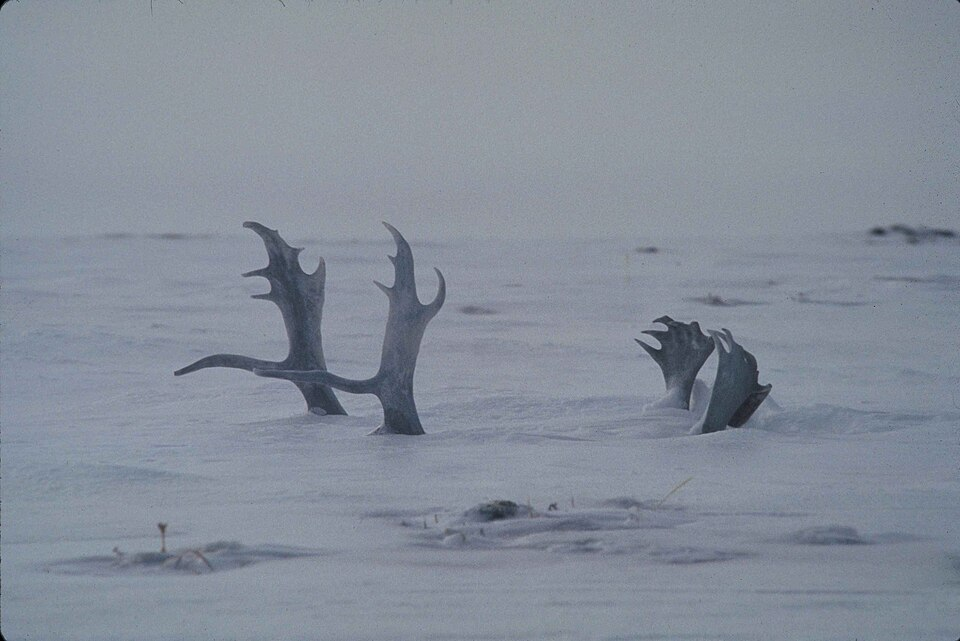
“Caribou antlers in snow” (1997 or later), Brian Anderson. Courtesy of the Digital Public Library of America.
In the darkness of the fields, she waited, seated on the dirt as the horned man came for her. She had first thought the horns he wore were those of a caribou. They were just as grand, with moonlight gliding off their points like slivers of white off a calm lake.
They seemed much too heavy for his head, and this she knew well. A year ago, before his sickness, she had helped her father prepare a caribou they had slain. She had chopped off its antlers, nearly dropping them on the floor as she struggled with their weight. Those horns were now perched above their front door like slender arms reaching wide into the night. Even now the trophy thrilled her, for when she returned from night fishing, she would catch her breath and gaze at the wicked bone that had sprouted from the wood of her home.
Did this man see that?
He stopped just then, with his head raised against the growth of evergreen behind him. She could not see the colors he wore nor the fur cloak that must have been wrapped around his neck, for the night was biting. No arm raised in greeting or other movement made. Tucked against the dry fields that refused to grow, she traced his shape and realized she could not find where he separated from the blackness around him.
Tucked against the dry fields that refused to grow, she traced his shape and realized she could not find where he separated from the blackness around him.
In this tundra, there was green—faded and weak, but green nonetheless. In this land, they were free from the snows of the south and the demons that lurked among the white. When she had barely been able to walk, she and her family had traveled past the ice floes, the silence of the snowbanks choking her ears, in search of warmth. She had been carried on her father’s back during the journey with the rumbling of his voice traveling through her, switching from speech to lullabies like liquid. She would fall asleep to his low rhythm, her ear placed against his neck, and to the frantic whispers of her sister who preached about eyes of coal trailing after them—and who was later lost to the caves where the bears munched on bones and rocks alike, later lost but not soon enough. Her brother’s soft complaints had filled the air as he kicked rocks across the ground’s thinning white blanket while her mother, her throat torn by a raider’s knife, was absent of noise. She remembered crying whenever she saw her mother’s scar, as if the flesh there was churning, ready to gape open and drown her in blood and darkness. She no longer cried. She would not let herself.
They had settled here in a lone home among a scattering of trees miles from others. It would take days to reach the superstitious old woman’s cottage down by the river, a week to find the huntsman, and even more to find the doctor, who refused to leave his meager lodgings of deerskin and incense. Her brother had not lasted long with an infection spreading through his arm that blossomed from a coyote’s bite, until only brown and green existed for him.
She leaned forward and took a slow breath of chill air through cracked bleeding lips. The shape had not moved. The man had not moved. Only standing, with those horns placed on him like a bird’s perch. There was tilled land separating them by many yards. He was judging their harvest, judging this girl who exposed herself to the dead winter. She refused to go inside to her father coughing, his deep voice now a rattle of weakness, or to her mother, whose scar was all she could see.
She remembered crying whenever she saw her mother’s scar, as if the flesh there was churning, ready to gape open and drown her in blood and darkness.
She realized then—the figure had not come down the traveler’s path. No, he had materialized out of the trees, from where the grim guardians of the southern lands ruled to serve the cold and nothing more. Her father had sung such stories to her, of conquerors once satisfied to rule from their high icy thrones until the day they had decided to venture past their keeps. Her grandfathers had escaped to lands of green, but the guardians’ hands held pikes of silver and chains of mist, as the winter winds blew at their backs, spurring them to chase.
When the flakes eventually came down, they packed and left again. A risk to stay, so they traveled far. A risk to stay, for it was in the snows where one loses their soul.
“Rest, sleep, my dear, as we run,” her father had sung, strong and sure, to places where greener things existed, even if the warmth soon fled as well. “Horned shadows cannot follow, they cannot follow you. Where there is no snow, they are lost.”
This man was lost.
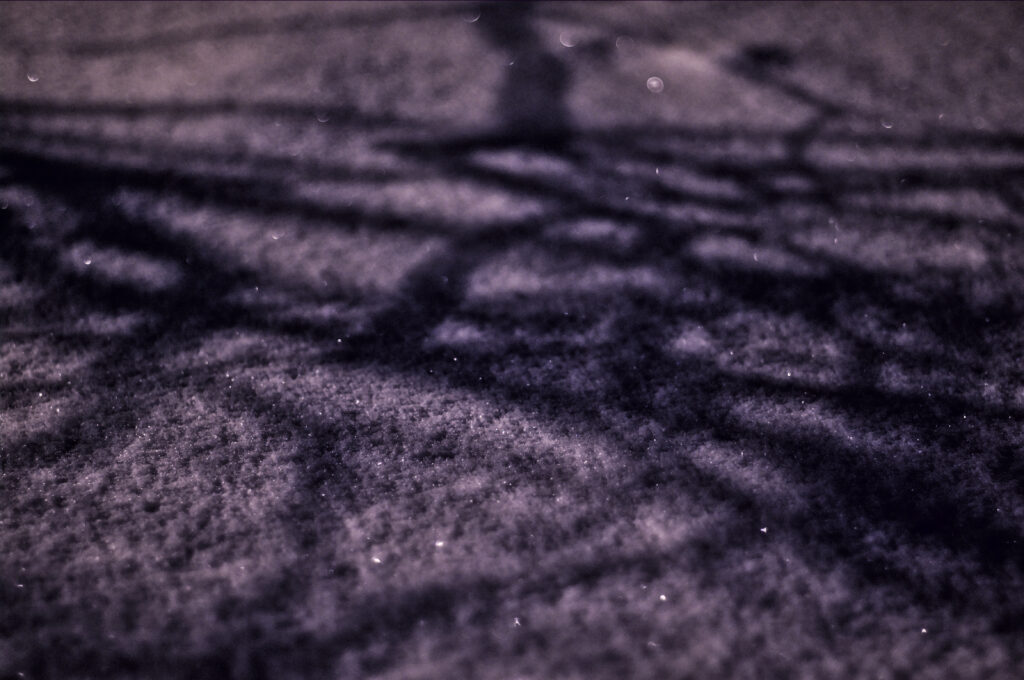
“Closeup of snow and shadows of branches” (2012), Kriomet. Courtesy of the Creative Commons Attribution–Share Alike 4.0 International license.
He walked forward suddenly, boots trampling the field’s meager sprouts. She stood up, shivering in bare feet that felt the sharp-edged pebbles drive into their skin. She had not planned for this stranger. She had not planned for anything. All she had done was stomp out of her home, threatening to run, only to be stopped by a glance at the antlers overhead, begging and reaching for her presence. So in the cold she had waited, hearing the walls echo with her father’s sickness and her mother shuffling across the floor. She had waited with eyes shifting to antlers whose very edges were coated in frost, even though this was a land where snow should not have found its way. The old woman, fearful and knowing, had seen the hints of ice and hissed, “You stupid girl.”
But the antlers were ever inviting. The horned man raised his head, seeing it grace her door.
The moon was full that night and surrounded by stars that pricked against the black, yet his face remained hidden from her. The world shrunk, bringing him to her. He was tall, so tall, like a mountain overburdened with snow, where a whisper would bring its brute strength down upon foolish heads.
There should have been no snow here.
The horned man stopped again. He kept his eyes on the door, above it. Then, he slid his gaze to her.
I did not wait for you, she wanted to say, for she had not meant to wait for anything. Instead she kept her lips shut. He was close now—not enough for an arm to reach out—but enough to see her eyes, for her to see his.
She had not planned for this stranger. She had not planned for anything.
Before her sister had rushed to the caves, to where bears were starved of both sunlight and meat, she would continually speak about those they had run from. She had to, because their father no longer could and their mother was useless.
“Where snow falls, they will follow,” she had wept one night, keeping her from sleep. “They follow and they follow until they take your souls. It’s for them, they say. Only for them.” Every night, she would speak of this. Every night, she would weep until she found the caves, brought on by a sibling dare.
The horned man was lost.
Winter nights were times of unyielding isolation and contemplation. The horned man was both as he gazed down at her with eyes dark but face meaningless. She once had dreams of a face looming at her window. Upon waking, she would never remember, for the face, she realized, was also meaningless. The eyes, those deep wells, held nothing for her, only a pitch-black that reflected a lone girl, threaded to the man’s gaze. Her sister had preached about eyes of coal. The guardians would pluck out their own and replace them with such stones. Stones painted black, hard against the ice and snow. They are lost without their beloved snow, without those winds of ice tugging at their hands full of pikes and chains, for what could coal see?
The eyes, those deep wells, held nothing for her, only a pitch-black that reflected a lone girl, threaded to the man’s gaze.
The horned man looked down at her, silent, overbearing. He waited for her.
She looked down to his feet, hoping to find a shadow that trailed across the dead fields, that extended into the evergreen and into the south where snow and ice thrived. Her father had sung of shadows topped with horns, creatures they were forbidden to hunt in a land of white. But there was green here—and in green, the horned demons could not follow, and their laws did not apply. He sang to her, We run and they cannot follow.
It is only in the snow where the soul is lost. So, she had no fear as she looked at him. She simply turned away. The antlers stretched and reached for her hands, welcoming her home. She flicked a glance over her shoulder and found the horned man close behind her. She saw his breath, forming clouds of mist before his face. It was cold, yes, but there was no snow here. Through the door, she could hear her father wheezing, his own breath stuttering, the air whistling through his ribs.
The horned demon was lost, but she was not. So, she welcomed him home.
There was a wooden house by the forest outskirts, where the fields were barren, that had been empty long before anyone noticed. The huntsman had been the first, hallooing at the door with freshly skinned venison on his sled, which he offered in trade to those in need. None answered, and when he went to open the door, the antlers pointed low, their tips sharp and dripping with ice. He left hastily without a glimpse back.
A month after the huntsman’s visit, the old woman circled around the house, shaking her head furiously at the antlers, where icicles now formed from their ends. “This will fall, this will fall, and this will truly be the end,” she whispered as she fell to her knees, digging her hands through the soil. She searched for traces of warmth, of where the sun must have left its presence in this land far from the south. But the soil was hard, and all she had left were bleeding fingers, as if a wolf’s teeth had gnawed on them for hours.
The last to come were a pair of outlaws: one wanted for murdering his wife, the other for stealing his neighbor’s cattle. Good fortune it was to find a home waiting for them—a place to finally rest their heads, even if the fields were worthless and the windows were dark as pitch. One stepped on the porch, undeterred by the door hanging open on rusted hinges, yet one step was all it took for the antlers to suddenly fall from their mount on the wall. They broke in half. The antlers’ icicles shattered like weak chimes, and the inside of the bone was as white as the frost that lined the wooden railings. The man swore to the other that a wind blew from inside the house, numbing his face and freezing his tongue. But as he spoke, he abruptly rushed off, yelping and screeching. For shadows were there, still and tall, like a mountain ready to fall, waiting for fools to approach. His dreams would later be infested with that image, enough to stop his heart years on.
No one came after. The snow had fallen then, blanketing the fields, the evergreen, the huntsman’s home, the doctor’s lodgings, the hissing woman’s grave, and the young girl’s bones where bears munched on stones and ice alike. All had run, for in the snows, the guardians of the south would not be lost, and they would carry pikes of silver and chains of mist in their hands.

Cassandra Rodriguez
Publab Fellow 2026
Cassandra Rodriguez is a freelance copyeditor and proofreader who dabbles in creative writing in her spare time. She is also an avid reader of fantasy, science fiction, and folklore, and continues getting too many books that can no longer fit on her shelves. “Heretics” is her first published piece, which itself is an homage to folk stories and fairy tales that have inspired her over the years. Originally from New York, Cassandra now lives with her partner in Southern California.