
On Body Horror
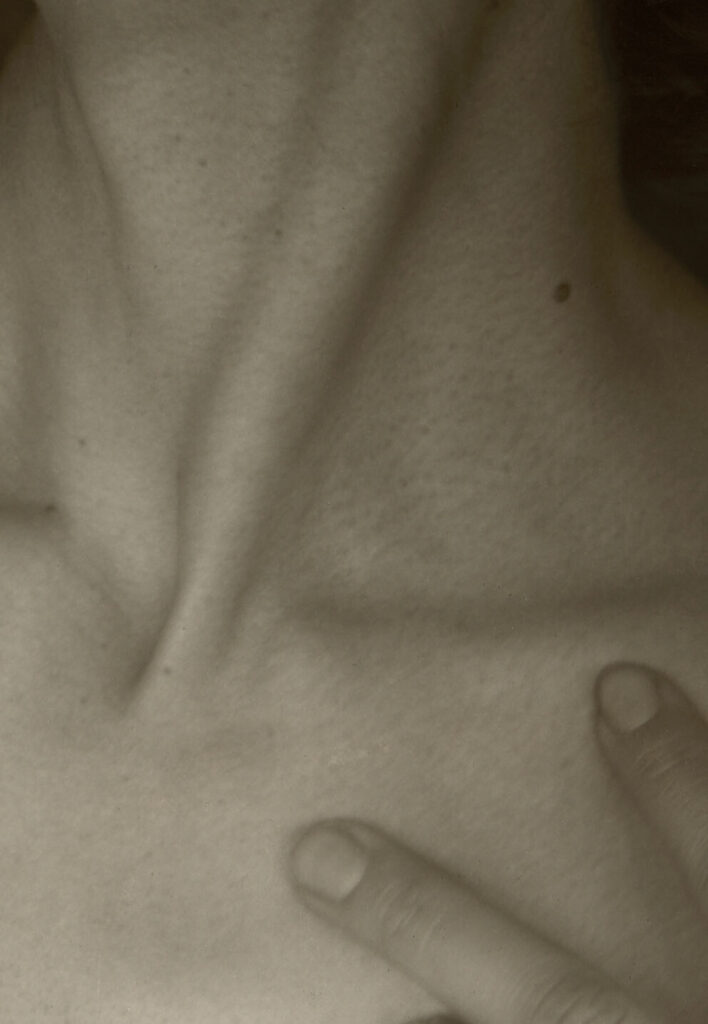
“Georgia O’Keefe—Neck” (1921), Alfred Stieglitz. Courtesy of the Art Institute of Chicago.
I WALK INTO a job interview with my mind divided between answering the questions and keeping my tics at bay. I tell my body to sit still and relax my face into a soft, hirable smile. In response, my knee bounces, my hands flex, and my brow furrows. I beg my mouth to fall silent as I settle into the quiet room, but it has things to say and noises to make. Yet for all the energy my body seems to possess, the bags under my eyes betray my fatigue as I relay my work experience. I tell my body that it’s time to focus; suddenly, it seems to have exerted the last of its energy. I am lured out of consciousness by sleep. I don’t want to sleep my life away, I think when the interviewer asks me to describe my aspirations. I’m just so much less tired in my dreams. I feel, in moments like these, like my body is betraying me.
A silver lining to this betrayal is that I fucking love body horror. I find it so satisfying to read about someone whose body turns on them in bizarre and grotesque ways, not unlike my own experience. When I underwent puberty, I watched my body grow and contort into something I had to turn away from. This misaligned process of taking shape in all the wrong ways as a young trans and disabled person was not one that I saw commonly represented in literature. Authors seemed unwilling to face the reality of a disabled, queer body, or perhaps publishers were afraid of platforming those kinds of stories. I came to find comfort in the next best thing: books about bodies that are queered through horrific transformations.
Authors seemed unwilling to face the reality of a disabled, queer body, or perhaps publishers were afraid of platforming those kinds of stories.
So, when I read Andrew Joseph White’s Hell Followed with Us, I felt that the connection I drew between my transness and a monstrous transformation had finally been seen. Benji, the protagonist, is both trans and is transforming into a monster at the hands of his family through cult-like religious experiments. His transformation neatly parallels my own experience of undergoing puberty—like Benji, I felt like my body was taking a monstrous form, one that met the expectations of everyone around me except myself.
Body horror forces readers to feel the discomfort that some trans and disabled people feel daily. I can explain at length the reality-bending nature of gender dysphoria. I can tell you how I feel as though I am running on an old phone battery—one without the ability to power save, or recharge unless you bend the adapter wire at just the right angle, or try unplugging and plugging it back in just to find that you had it right the first time. But if you’re someone who recognizes your reflection each time it stares back at you with the telltale spark of energy behind your well-rested eyes, then it might take a bit more to get the idea across. Body horror presents you with the explicit image of a fleshed-out character turning into a body that’s falling apart.
Body horror presents you with the explicit image of a fleshed-out character turning into a body that’s falling apart.
This kind of dysphoric body horror is everywhere in contemporary fiction. Ling Ling Huang’s Natural Beauty, for example, tells the story of a woman who undergoes a terrifying transformation. The novel’s unnamed protagonist works in the beauty industry and is coerced by her shady employer into using their experimental products. Unlike in Hell Followed with Us, the protagonist does not, at first, become a monster. Rather, the novel’s body horror takes the form of gradual changes that make her unrecognizable. The products completely change her Chinese features—her eyes, skin, and hair grow lighter, her legs and fingers lengthen, and her face reshapes until she finally looks into the mirror and cannot recognize the features she inherited from her parents. Those around her are not appalled by her whitening. In fact, they envy her new adherence to a white beauty standard. Eventually, her features distort and swell, obscuring the new face that does not match her identity. As the novel shifts into a more horrific register, the reader is pressed to understand that the changes to her appearance throughout the novel are imposed on her without her informed consent and erase her sense of self.
Natural Beauty reminds us of an uncomfortable truth: our bodies are not under our own control. Able-bodied readers may think that their brains send commands to their bodies, which, in turn, act according to their wishes. Perhaps this is the case for some. But think of when you get sick. Can you will your sinuses to clear and your throat to soothe itself? Try as you might to fend off the aging process with serums and injections, can you ever truly maintain your youth as the decades unfold? It may be your body, but you are not in control. When you recognize that, you come a little bit closer to understanding disability.
It makes sense to want control over our own bodies. They are the unavoidable vessels through which we conduct our lives. If we cannot control our bodies, we cannot control our lives. Disability restricts our ability to conduct our bodies with ease without accommodations, which are concerningly scarce in everything from our work culture to our infrastructure. Able-bodied people fear the day—which will come—when they cannot order their bodies to obey them in the way they’ve grown accustomed to. Body horror feeds on this fear: the fear of becoming disabled. What many people have yet to reckon with is that the body has limits. It is also inevitably, and tragically, always going to be perceived. The feeling of alienation that comes from the mind-body disconnect caused by gender dysphoria, dysmorphia, and disability is only amplified by the social forces of shame and racialization. The body, in these ways, is made into an object, subjected to our world of tyrannical and racist standards of beauty and ability.
Able-bodied people fear the day—which will come—when they cannot order their bodies to obey them in the way they’ve grown accustomed to. Body horror feeds on this fear: the fear of becoming disabled.
What a long history we have of people being taught to believe that they were subhuman because their bodies were othered. Through this othering process, individuals of marginalized experiences are reduced to mere bodies. They become monsters, without the dignity of having a mind. No wonder so many have an affinity toward Frankenstein’s monster, who knew he had worth beyond his creator and public perception. But we see how he, too, is likened to a brainless zombie in the popular imagination.
In all the gore and monsters that we are conditioned to be repulsed by, there are those of us who feel represented. We see guts ripped out on-screen, and it feels similar to our experience of having a body that is in conflict with itself. We see how others cower from monstrous or queered bodies, and we recognize the feeling of isolation. Body horror represents the experience of marginalization and gives those without such experiences a peek behind the curtain, while providing the comfort of being seen to those whom the gore resonates with.
Adrian Mendoza
Publab Fellow 2026
Adrian Mendoza is a writer across disciplines and a reader across genres. They got their start as a writer and editor for their high school newspaper club, then went on to write for the Daily Trojan, Annenberg Media, and serve as managing editor for Trojans360 throughout college. Since graduation, Adrian has maintained a Substack called Read by A, where they post book reviews and discuss all things bookish. Adrian believes in the importance of representation in literature and hopes to take part in expanding the scope of diverse representation in the publishing industry at large.