
“No suelte’ la bandera ni olvide’ el lelolai”: (Re)Imagining Lo Jíbaro From Manuel Alonso to Bad Bunny
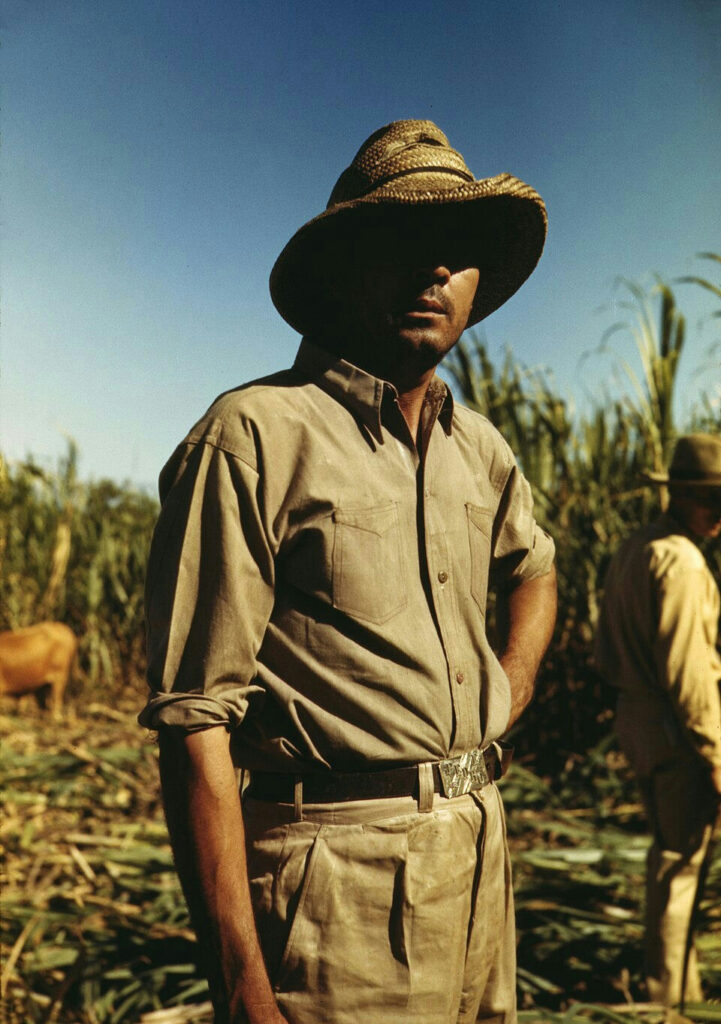
“Man in sugar cane field during harvest, Puerto Rico” (1942), Jack Delano, Photograph. Courtesy of the Library of Congress.
When I first saw the NFL and Apple Music’s announcement that Benito Antonio Martínez Ocasio, professionally known as Bad Bunny, would be the sole headliner for the 2026 Super Bowl halftime show, my knee-jerk reaction to the post was: “Is this an AI fake?” The image featured Bad Bunny sitting on a field goal post wearing a “pava,” a traditional straw hat that is emblematic of the Puerto Rican peasant or countryside farmer called the “jíbaro.” I couldn’t believe that Bad Bunny was bringing a pava, a symbol of Puerto Rican national identity that felt so insular yet so proudly our own, to the center stage of quintessential North American media and pop culture. This wasn’t a small gesture by any means; it alluded to the centuries-long struggle to define Puerto Ricanness.
Despite being so emblematic of Puerto Rican culture today, the jíbaro is a polarizing figure. Originating in the nineteenth century as a caricature of the impoverished working class who inhabited the mountainous interior of the Island, the jíbaro is an imaginary representation crafted by the bourgeois intellectuals who populated the cities of the coastal plains. This geographic, economic, and social divide generated friction as the elite sought to define an autonomous Puerto Rican national identity under Spanish colonial rule. The jíbaro was thus constructed as a mythological figure, a means of imagining the identity of a nation that was yet to be built.
Echoing this history, Bad Bunny’s halftime show opens with jíbaros wearing pavas and wielding machetes as they work in a sugarcane field. This mythified image of the jíbaro began with El Gíbaro: Cuadro de costumbres de la isla de Puerto Rico by Manuel Alonso. Originally published in 1849, this lengthy collection of essays and poems was the first to attempt to portray the everyday life of the jíbaro. Alonso writes in the costumbrista style typical of the nineteenth-century Hispanophone world, a genre characterized by “estampas” or stamps that depict the customs and social life of rural populations, like still lifes captured in words on a page rather than in paint on a canvas. However, in true costumbrista fashion, these stamps romanticized rural life and filtered it through the perspective of outside bourgeois intellectuals looking in and interpreting what they saw according to their own sociopolitical agenda.
The jíbaro was thus constructed as a mythological figure, a means of imagining the identity of a nation that was yet to be built.
In Alonso’s case, his representations of jíbaros and their way of life were also moralizing in nature. In his eyes, and in the eyes of other reputable intellectuals of his generation, the Puerto Rican people had raw potential but needed education and guidance before it could be actualized. Despite their liberal, democratic, and at times even revolutionary ideals, Alonso and his peers believed that progress for the Island meant leaving the mountains, abandoning tradition, and moving to the coastal cities in order to achieve an autochthonous and modernized future free from Spain.
In line with this vision, Alonso characterizes the jíbaro as an ignorant, lazy, uneducated, and uncultured figure still clinging to tradition out of a proud but naive stubbornness. Most importantly, he represents jíbaros as a dying breed, one deemed worthy enough of remembering but not of preserving. Alonso and his peers saw the value in capturing jíbaro customs and culture, but already thought of them as a thing of the past, fated to disappear naturally on the path towards civilization and nation-building. In doing so, they constructed the culture of the rural class as folklore. History is written by the literate, after all.
In “Escena XI” of El Gíbaro, Alonso composes a poem titled “La fiesta del Utuao” in which he narrates the humorous tale of a jíbaro who attends a party in Utuado, one of the smallest municipalities in the mountainous interior of Puerto Rico. There, he experiences a series of mishaps that lead him to decide to never set foot in Utuado again. By writing in the first person, as if he himself were a jíbaro, Alonso lends a false sense of veracity to the tale. What’s even more curious is that he writes the entirety of the poem in jíbaro speech. He mutates the spelling of “neutral” Spanish to capture the particularities of their spoken dialect, a stylistic convention that later became recognizable as the jíbaro accent. Through this characterization, he turns jíbaro speech into a trope, a performance that discloses the fictionality of the jíbaro figure.
The poem begins with the jíbaro speaker addressing a friend as he recounts his adventures in Utuado:
Escuche, compaire Pepe,
ya que haseyo me ha obligao
lo que le boy a contal,
que es caso que me ha pasao.
Manque no soy de la Bana
tengo mi aquey muy fundao,
polque soy de Puelto Rico
er chenche más afamao.
A mi nengún endivido
en la vía me ha cucao,
sin que le dé un sopetón
que lo deje ñangotao;
Y por eso los alcaldes
dey pueblo del Utuao
tuvieron que vey conmigo
este mesmo año pasao.
The jíbaro insists that the tale he is about to tell is very much a true story. He talks himself up, wanting to command respect, but it comes across as a cocky front. The poem continues in a braggy tone as the jíbaro details how he arrives at the party on a “cabayo manchao” (spotted horse), wearing a hat “de beinte riales” (that cost 20 bucks) and “carsones de crea pol supuesto aymionaos” (linen pants that are, of course, starched), and that he eats “arros con casne” (rice with meat) and another plate of “guisao” (stew). Then, the jíbaro dances with a “jembra” (woman) until he accidentally steps on her “enamorao” (beloved), with whom he has a fist fight and ends up in jail for three days.
Jisimos un sambumbiao
en menos de dos menutos,
que el Alcalde aturruyao
no sabía que jaser;
pero el cura, hombre abisao,
le aconsejó que a la cársel
nos yebara de contao.
Ayí nos tuvo tres días,
y yo salí escarmentao
para nunca más bolvey
a fiestas al Utuao.
Having learned a harsh lesson, the jíbaro resolves to never return to “Utuao” again. Despite accurately depicting jíbaro customs such as food, clothing, and even slang, Alonso projects an idealized and moralizing perspective on the jíbaro way of life, all while using jíbaro speech. Eduardo Forastieri-Braschi calls this the “mascarada jíbara,” or the jíbaro masquerade, a literary strategy used by Alonso and his elite peers to disguise their liberal views about progress and nation-building as coming from the mouth of a jíbaro.
In choosing to abandon Utuado, a place so emblematic of the Island’s mountainous interior and of jíbaro culture, the poem’s jíbaro functions as a puppet, its strings pulled by Alonso, forced to ventriloquize its own defeat. Bravado and violence get him nowhere. As the jíbaro leaves the mountain, he makes way for the creation of a civilized and educated Puerto Rican subject. In this way, the figure of the jíbaro becomes easily portable, a vehicle that transports and projects ideas (and ideals) of a national cultural identity that seem to come from within.
The final nail in the coffin: the poem is ironically funny. It’s hilarious, actually. I showed it to a dear childhood friend of mine who is also Puerto Rican and she found it so entertaining to read aloud. She got into performing it, and we laughed along. But as our laughter died down, the silence that replaced it tasted bitter. “How strange,” she said to me, suddenly painfully aware of her own mascarada jíbara, “it feels so relatable.” What makes the poem so funny, and so sneakily effective, is how Alonso clues the reader into the jíbaro’s cluelessness. It tricks us into making fun of ourselves, making us complicit in our own delegitimization—a Puerto Rican Trojan horse of sorts.
Even now, we continue to imagine ourselves as part of this amorphous past to which lo jíbaro is relegated. The dialect the poem mimics is still part of present-day Puerto Rican accents, and it is still commonly spoken in the broader Hispanophone Caribbean. And yet, to this day, to call someone (or even yourself) a jíbaro is to say that they are out of date with what’s current, hip, and trendy. To be jíbaro is to be out of the “know” in a way that connotes a willful, and even irresponsible, ignorance, like someone who digs their heels in and refuses to evacuate their house during a hurricane even as it floods and the roof is blown off. We cling to our house even as we are told it does not exist.
The figure of the jíbaro becomes easily portable, a vehicle that transports and projects ideas (and ideals) of a national cultural identity that seem to come from within.
After the Spanish-American War ended in 1898 and the United States took ownership of Puerto Rico from Spain, canonical twentieth-century Puerto Rican writers tried to rescue lo jíbaro and repackage it as patriotism. They did so amid an Islandwide panic to safeguard Puerto Rican identity as American colonizers attempted to censor the Spanish language and criminalize the flying of the Puerto Rican flag. However, their idealization of lo jíbaro backfired. Instead, they ended up mythifying a conformist Puerto Rican character that cannot see beyond its own insular perspective and is ultimately to blame for its own colonial condition.
This imaginary continues to plague ideas of Puerto Rico today. El Gíbaro is considered the first significant work of Puerto Rican literature, though it is not well known outside scholarly spaces. This alone is proof of a job well done—to which we’re not aware of the extent we historically and culturally imagine a Puerto Rican nation. A lack of cultural historiography amid five hundred years of colonization has left gaps in our collective imagination. We are left with no recourse but to ignore them or fill them in with fiction. Marta Aponte Alsina puts it best: “Cuando los pobladores de una isla no deciden lo que entra y lo que sale de ella, no fabrican los objetos que les rodean, no conocen ni entienden el origen y el sentido de las acciones que determinan sus vidas, la percepción de las cosas bordea la magia y florece el caos.” Bad Bunny fearlessly fills these gaps. He reaches beyond past representations of lo jíbaro in order to harness the potential of what could be, daring to imagine otherwise.
Bad Bunny’s halftime show is a mascarada jíbara of a different kind. During “LO QUE LE PASÓ A HAWAii,” a jíbaro plays the cuatro, the national instrument of Puerto Rico, as Puerto Rican artist Ricky Martin, also dressed as a jíbaro, looks directly into the camera and belts out pleading the lyrics for Puerto Rican sovereignty. The song ends abruptly and “El Apagón” begins with three jíbaros climbing up electrical posts that explode in a shower of sparks, simulating the commonplace blackouts that hit the Island. The jíbaros, now turned electrical workers, fall from the posts and hang by their equipment. This is a nod to the thousands of Puerto Ricans who have died due to government negligence in the aftermath of natural disasters and the millions more that continue to suffer the everyday injustices of living in a present-day colony. As the jíbaros climb back up the posts, Bad Bunny stands below them holding a giant Puerto Rican flag with a sky-blue triangle, the original color chosen by nineteenth-century revolutionaries before the United States’ colonial rule changed it to navy blue. Throughout the performance, lo jíbaro is reimagined as a force of resistance and persistence, still stubborn and proud but no longer naive. Now, it represents a people that are reclaiming their agency by rewriting the story of their nation. Forged in the midst of—and despite, and against—the colonial condition of Puerto Rico, lo jíbaro is a cultural symbol that merges with lo puertorriqueño and encourages us to imagine more: desde el pasado, en el presente y hacia el futuro. Estamos puestos pa’l problema.
Claudia Martínez Rivera
Publab Fellow 2026
Claudia Martínez Rivera is a Puerto Rican PhD student in Hispanic Languages and Literatures at the University of California, Berkeley. She holds a Master of Arts in English Literature Specialized in Feminist and Gender Studies from the University of Ottawa, for which she completed a thesis titled Yo digo lo que me da la gana: Using Spanglish Translational Strategies to Redefine Puerto Rico in the Poetry of Roque Raquel Salas Rivera. She also holds a Bachelor of Arts in English Literature from the University of Puerto Rico, Río Piedras. Her research interests include contemporary Puerto Rican poetry, translation studies, de/anticolonial theory and praxis, and literary and cultural production in the broader Hispanic Caribbean. She is also on the editorial board for Lucero, the Graduate Student Journal of the Department of Spanish & Portuguese at UC Berkeley.