
Home Made Wild

“Maize with Fabric” (2026), Holly Zhou. Courtesy of the artist.
In spring, we count snakes in the garden. The raised beds are built over what used to be an in-ground swimming pool. The walkway that once surrounded the pool is still in place; beneath the concrete slabs, snakes poke their heads out to reach the sun. They camouflage amid stone, dried leaves, and other detritus the winter has left behind, but look closely, and we find one, then another, and another. Most are small, but of the larger ones, we speculate which is the mother. We pull spring weeds from within clusters of dried echinacea stalks and find skins. Having lain there all winter, they come apart in our fingers.
I spend the warming days in a swing on the front porch, reading while a house wren, unbothered by my presence, builds its nest. Connor gardens behind the house; he calls me to the back. “Want to see some cool animals?” he asks. We stand on a wrought iron bench that my grandfather, whom I never met, built, which Connor refurbished after finding it in the tall grass behind the house. We peer at the log wall and see three baby snakes watching us from the cracks. The curve of their long bodies synchronizes with the grain as it rounds a knot in the wood, their dark scales and pale bellies matching the gradient of the logs. It is mainly the glint of their dark eyes that gives their hiding spot away, though they do not seem unsettled by our discovery.
They are either common garter snakes or eastern ribbon snakes; it is always difficult for me to be sure. Field guide descriptions that say garter snakes are stockier and ribbon snakes have longer tails and narrower heads don’t help much, especially when the snakes are partially hidden. I don’t imagine my lack of confidence in naming them unsettles them either. They are here, and we are here too, and we look at each other.
With its gaps, cracks, and notches, the log house offers an abundance of places for others to find shelter. The logs, which often exude sap, are rough and still treelike: an invitation to the creatures who live nearby. The snakes’ choice of hiding place softens any boundary between our home and the nearby forest. Together they climb the clematis vine, find refuge in the space between the logs.
Finding snakes in the walls is surprising, but perhaps not unusual. In Never Home Alone: From Microbes to Millipedes, Camel Crickets, and Honeybees, the Natural History of Where We Live (2018), ecologist Rob Dunn reminds us that we share our homes with many other creatures, both microscopic and visible, and we always have. Dunn and his colleagues estimate that they have found roughly 200,000 species in homes, including bacteria, fungi, plants, arthropods, and other animals. “In short,” Dunn writes, “homes include hundreds of species that have lived in homes long enough to evolve specific adaptations for indoor dwelling, species that have, whether or not we pay attention to them, been a far more predictable feature of our history than, say, democracy, plumbing, or literature.” Dunn posits that the more wild our homes are, the better off we are: beneficial species may keep more harmful ones at bay; increased biodiversity in our homes may improve our microbial biomes and reduce our susceptibility to allergens; and paying attention to the other species we encounter in our homes increases our sense of wonder and curiosity.
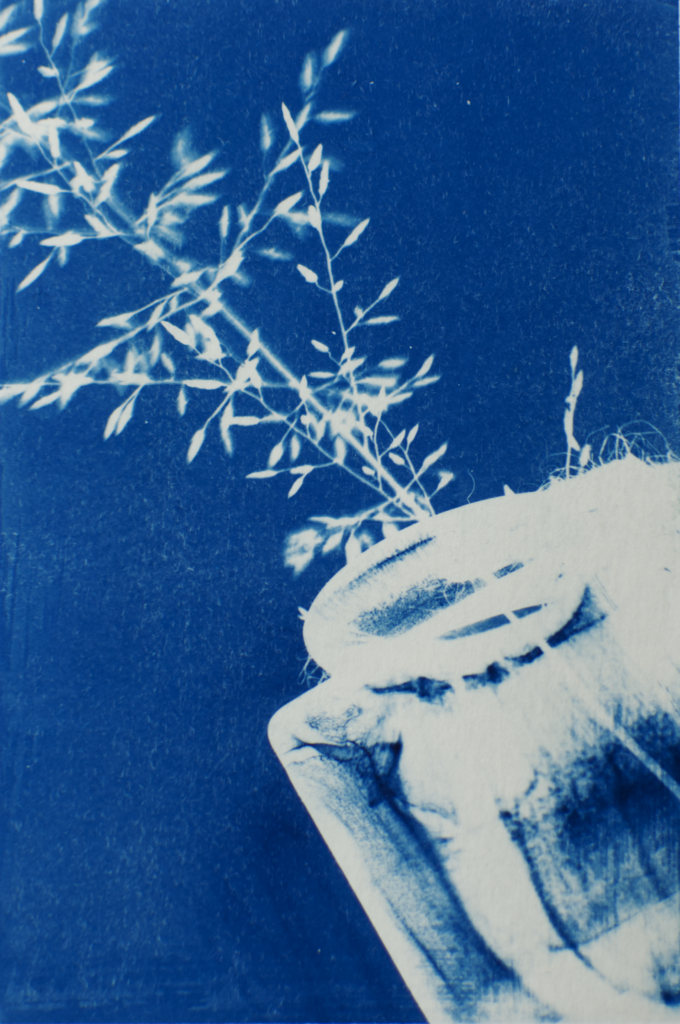
“Switchgrass in Glass” (2025), Holly Zhou. Courtesy of the artist.
But closeness is not always comfortable. I realize that wonder may not be the first feeling many have when encountering animals like snakes or bats within the space of their own homes. So many of the creatures that come inside are classified as pests, controlled by extermination, simply unwanted. Like most people would be, I am also invested in finding ways to keep animals from getting inside in the first place, and preservation of the log house requires limiting inadvertent destruction by animals that chew their way through wood, wire, or insulation to simply make their own home.
A window to the forest and closeness to its noises meant that both the house and I dwelled in the woods. Even as my parents tried to seal the house, it provided no barrier to creatures wanting to come indoors.

Jenna Gersie
Publab Fellow 2026

Holly Zhou
Publab Fellow 2026
Holly Zhou is a writer and mixed-media artist from the California desert, the unceded territory of the Cahuilla and Mojave peoples. Working across video, electronics, sound, software, bookbinding, and collage, Holly’s projects curate experiences mediated by play and a poetics of liberation. Their collaborative installations have been exhibited in places such as the New City Arts Gallery, the Field Projects Gallery, and the Ely Center of Contemporary Art. More of their work can be found at hollyz.cc.