
Enter the Pyrocene…Through Sebald: How W. G. Sebald Anticipated a World Full of Fire
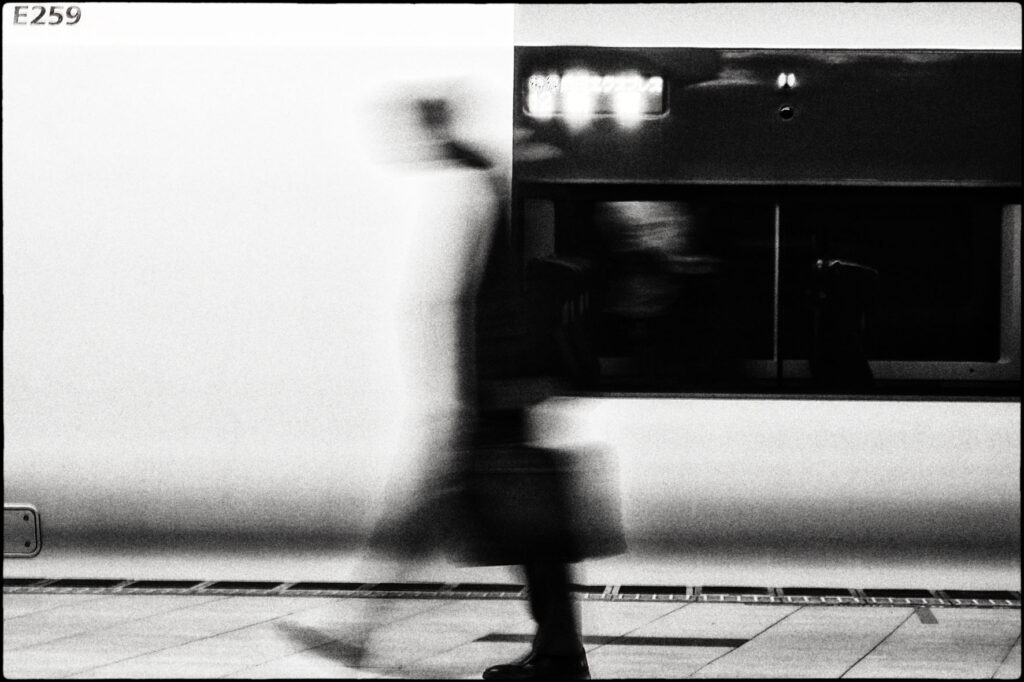
Ghost Session 2. (2016), Mildiou. Courtesy of Flickr
IN TROUBLED TIMES, works of fiction blaze a path between bygone eras and the present. The best stand the test of time and offer a cogent perspective on our present world. Readers looking for insight into our twenty-first-century world and some of its foremost struggles—ecological disaster, the violence and trauma of endless war, and the problem of how to confront difficult histories—might not look to a book published in the early 1990s. Yet, one such novel, W. G. Sebald’s lesser-known Vertigo, may be more relevant to today’s psychological and geopolitical landscape than most realize.
First published in German and then translated into English nine years after its original release in 1990, Vertigo is often overlooked by both lay readers and scholars of Sebald alike. The novel is overshadowed by Sebald’s three subsequent and more famous works of fiction: The Emigrants, The Rings of Saturn, and Austerlitz. However, Vertigo may be the best way to understand Sebald’s writing and the most cogent, enduring aspect of his authorial style: the repetition of motifs. In particular, tracing the motif of fire shows us how Sebald’s Vertigo remains a book for our contemporary moment—what many now call “the Pyrocene.”
Vertigo is a novel written in four chapters, each containing a stand-alone plot and moving between time periods and settings. Part travel story, part biography, and wholly fictionalized, Vertigo transcends a definitive notion of genre. Without a central plot to ground its narrative, Sebald’s repeated themes are the key source of cohesion for the novel.
Since its publication, two of the novel’s chapters—biographical short stories about the authors Stendhal and Franz Kafka and their paralleled travels in Italy—have received the majority of its critical attention. While these chapters have been the primary source of Vertigo’s acclaim, it is the other two chapters that offer a more complex and intimate look into Sebald’s literary prescience—chapters where fire emerges as a motif that haunts the book. A reading of the less-studied chapters of Vertigo, and particularly Sebald’s use of fire, offers us a way of reflecting on today’s ongoing climate crisis and the psychological effects of living in a world on fire. It is Vertigo’s omnipresent fire that resonates and gains new relevance in our contemporary moment.
It is Vertigo’s omnipresent fire that resonates and gains new relevance in our contemporary moment.
The first chapter in question, the second of the book, titled “All’estero,” revolves around an anonymous narrator who travels around Italy and Austria following, in a sort of pilgrimage, the itineraries of trips taken by Stendhal and Kafka. On this journey, the narrator encounters a darker, more melancholic Europe than his literary predecessors. Traveling in the 1980s through Vienna, Verona, and Venice, the narrator wanders the city streets and moves by train and bus, never feeling quite at peace on his journeys. Similarly, in the fourth and final chapter, “Il ritorno in patria,” the narrator travels to his hometown of “W” in rural Germany, where he is confronted by memories of former townspeople lost to time as he visits places he remembers from childhood. The narrator’s travels subvert the typical vacation story. The landscapes here are bleak, depressing, and haunting. Europe is not a place of fantastical retreat but a site of confrontation, as the narrator finds himself preoccupied with the unavoidable reminders of past destruction from war, the legacy and loss that flood historical sites, and the heaviness of life’s cyclical nature. His travels are existential and somehow always punctuated by the presence of fire.
Ecological destruction is at the forefront of Sebald’s ruminations, and fire looms as a primary stressor for the unnamed narrator in Vertigo. Everywhere he goes, the narrator is reminded of fires that have ravaged cities. He imagines fires popping up where he stands; he compares much of what he sees to blazing red, ruinous flames. Our first peek into the fire motif arrives in the second section of the novel, part of which centers on the narrator’s preoccupation with a criminal organization called “Ludwig,” a reference to the real-life Italian neo-Nazi group active in the 1970s and ’80s. While eating at a pizzeria on his first trip to Verona, the narrator comes across a newspaper story that connects the Ludwig organization to multiple murders across Northern Italy. Ludwig’s preferred method of murder is by fire. Later, in the fourth chapter, the narrator returns to Verona years later and learns that Ludwig has again committed multiple murders by fire—their proclaimed purpose being to “destroy those who had betrayed God.” Wielded in this way by Ludwig, fire is framed as purifying but is destructive and always leads to death. In both instances, hearing reports of these murders by fire causes the narrator to board trains and physically remove himself from Verona—even though he himself is not under direct threat from Ludwig. The transtemporal Ludwig storyline indicates that fire is an omnipresent, viscerally traumatizing force for the narrator.
Fire also occupies the narrator’s memories of his childhood in rural Germany. In the final chapter, “Il ritorno in patria,” when he revisits his hometown and retraces his childhood steps, contemplating the eerie fires that occurred there, he notices “flame-red […] trees […] blazing on the sides of the mountains.” He thinks of the old fire station, the taproom with its blazing iron stove, and the sawmill that burned down. He remembers school lessons about the fires that ravaged his hometown over the course of many years. He even spends the final pages of Vertigo reflecting on the Great Fire of London. The pattern of fire adds to his troubled state rather than relieving or purifying it. There is no escape from the world of fire he finds himself in, much like we may feel toward the world we face today.
The introduction of fire into the storyline always prompts our narrator to act: fire triggers his impulse to flee. It prompts him to be in a ceaseless state of movement, always traveling, yet never quite able to avoid the flames.
Sebald’s use of fire as a repeated motif in Vertigo signifies the acute presence of death. However, while fire, whether manmade, as in the Ludwig murders, or naturally occurring, always threatens the narrator, it is something he can run away from. Yet, Sebald nimbly constructs a double trap: where fire (literal or conjured) is escapable, the narrator will always be met with the unavoidable trauma and destruction that haunt the landscapes he traverses. In this way, fire is the narrator’s personal memento mori.
In this way, fire is the narrator’s personal memento mori.
Today, fires are a pervasive apocalyptic feature of our everyday life: annual wildfire devastation of natural and urban landscapes, fossil-fuel combustion, elongating fire seasons, and smoke plumes large enough to cross oceans. Sebald’s narrative anticipated the totalizing effects of these fires that characterize our contemporary era and current planetary epoch: displacement, constant movement, destruction, and psychological violence. Most of all, Vertigo’s repetition of fire presciently tells a story of fire’s unavoidability. Life under the intensifying conditions of climate change, where late capitalism’s hunger for accumulation drives further ecocide and encourages wild and chemically-enhanced fires, makes large-scale fires inescapable. By returning to Vertigo, we might find resonance between the narrator’s story and the existential dilemma fire elicits in the contemporary subject. Here, Sebald’s novel makes us confront a terrifying reality: that however much we may try to avoid it today, fire follows.

Sophia Meimaris
Publab Fellow 2026
Sophia Meimaris is a second-year MA student in the Department of English at Georgetown University. She specializes in postmodern literature, with an interest in global literature and metafiction. At Georgetown, she is a teaching assistant for the Prisons and Justice Initiative and teaches undergraduate courses at a prison in Maryland. Additionally, she works for the Undergraduate Programs Office at the McDonough School of Business. In the world of publishing, Sophia is interested in translation and global literature, adaptation across media, and working closely with authors to bring new literature into the world.