
Daniela Martén Rothe Portfolio
Daniela Martén Rothe’s collection Sensual Tropical Limbic promises an awakening of the senses and of the mind. As you read along her journey, allow yourself to dive in these sensual images of nature, femininity and the power of the erotic.
Martén Rothe grew up in the city, in one of the most traffic heavy neighborhoods of San José, the capital of Costa Rica (and my home country too). But in the tropics it rains eight months out of the year and, like Daniela says, “nature sprouts even out of the walkway’s cracks. She had a special connection with a tree, a mango tree that grew in her backyard, “its ecosystem was the main stage to my childhood,” Martén Rothe remembers. That backyard was home to orchids, plants and vines, anything her mother and grandmother collected during weekend trips out of the city. Martén Rothe’s bedroom window hosted a beautiful orange Flame Vine, that would sometimes have to be delicately hacked in order to close it at night. “Nature was always just an everyday spiritual and loving presence in my life,” Martén Rothe reflects, “that’s why nature is a protagonist in my art, a living territory where the human, the feminine and the sacred converge.”
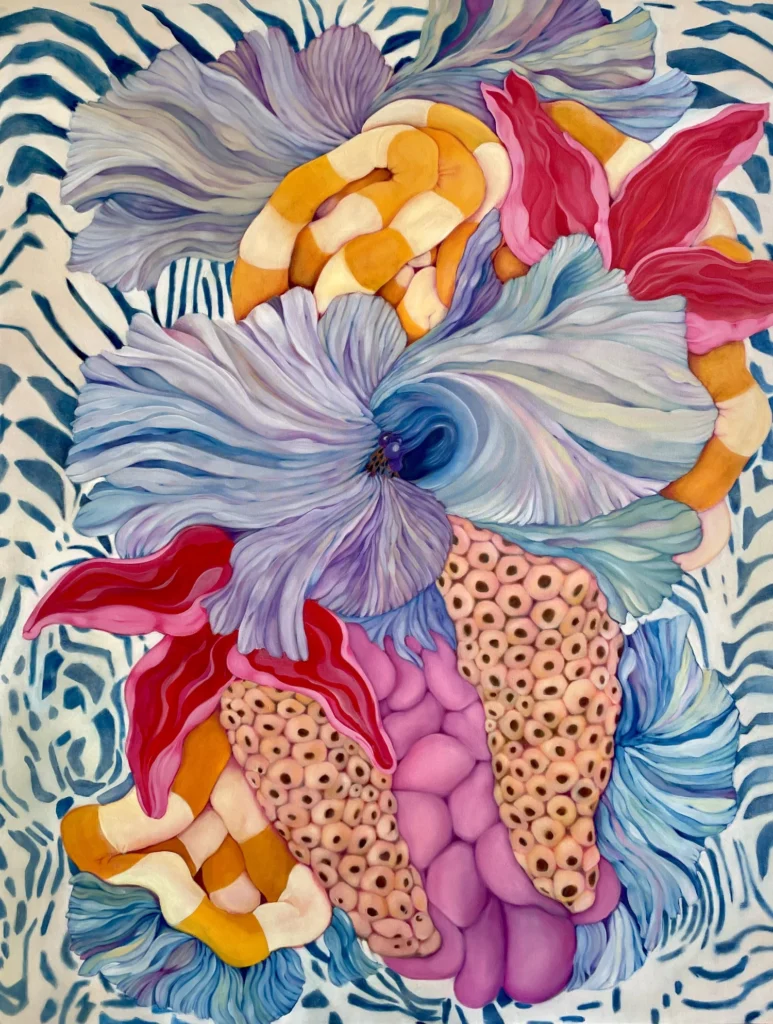
“Candy Tropical” (2021) Oil on canvas. 150×120 cm. Copyright Daniela Marten Rothe (2026)
The Sensual Tropical Limbic series by Daniela Martén Rothe is inspired by the concept of “Anasuromai” or “Anasyrma” which comes from the Ancient Greek ἀνάσυρμα (“lifting the skirt”), and refers to the deliberate act of raising one’s skirt to expose the genitals. The action of anasyrma has been recorded through history books in all continents and across several centuries.
Martén Rothe was immediately taken by this act as a limbic response inherently human, no matter the geography. And it was with this in mind, that she started looking at nature, and nature’s genitals aka flowers, through a different light.
“Nature,” the artist says, “continually displays erotism and sensuality, presenting its flowers with pride, tempting their audience with its diversity of colors, shapes and aromas.” “The erotic,” she continues, “is not exclusively human. It is one of the most fundamental forces of all life.”
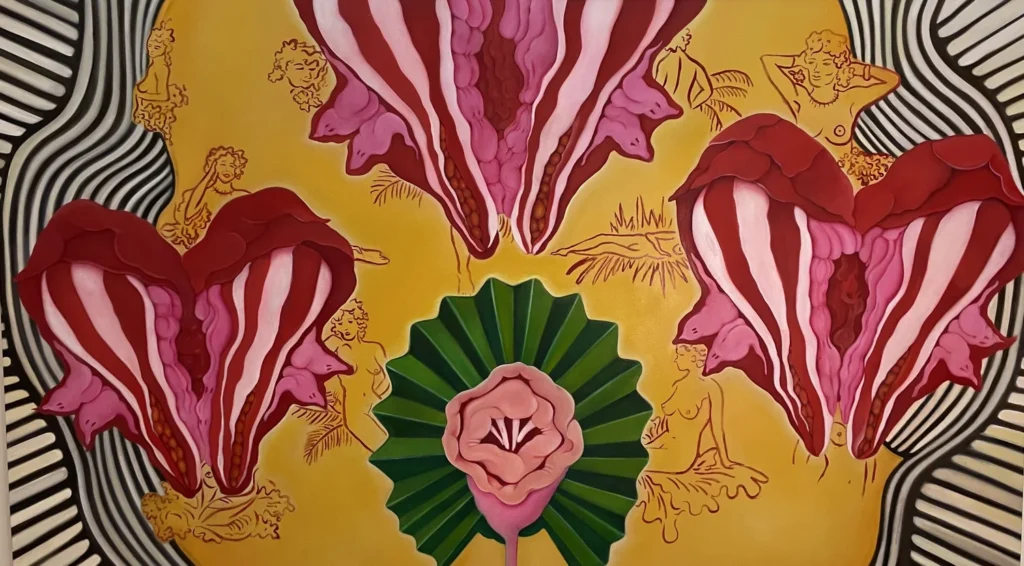 “Anasuromai” (2022) Oil on canvas. 112×198 cm. Copyright Daniela Marten Rothe (2026)
Martén Rothe found inspiration in Anaïs Nin’s writing and in Audre Lorde’s “Uses of the Erotic.” She went down a rabbit hole of research into history and botany. “For me, the erotic cannot be separated from desire and desire is the force behind the act of creation, of transformation, of taking up space. That’s why I’m interested in highlighting female power through sensuality and the erotic because historically we’ve been denied the access and the freedom to express ourselves that way.”
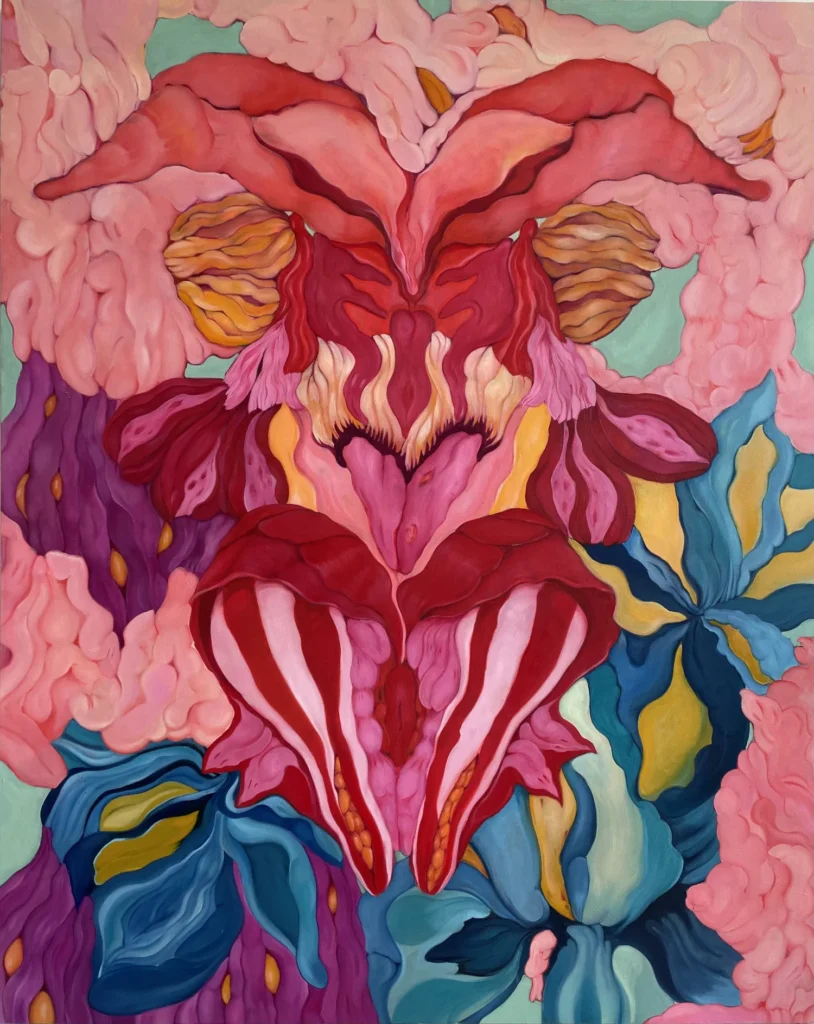
“Diosa Lenguona” (2021) Oil on canvas. 150×120 cm. Copyright Daniela Marten Rothe (2026)
Martén Rothe says about her art that, “I create as means for expression of the female psyche, the exploration of eroticism and the search for freedom through sexuality as a way to counteract female oppression.
The exuberance of flowers is manifested in an exhibitionism of their reproductive parts without censorship, which constantly seeks attention with an explosion of colors and shapes that fascinates us.
Unlike the genitals of human beings that are asked to be covered, hidden and considered immoral, the flowers in their exhibitionist carnival are positioned in places of great distinction and visibility, and are used to honor even the most solemn rites such as deaths, births, marriages, etc.”

“Carnaval” (2021) Oil on canvas. 150×120 cm. Copyright Daniela Marten Rothe (2026)
The painting titled “Beso” or Kiss, sparked my curiosity and I had to ask Martén Rothe about her first kiss. I wanted to understand how that fundamental experience might have shaped her perspective today.
Haha, okay!” She replied. “Back then we used to go to Cahuita (a beautiful and rustic beach town in the Caribbean coast of Costa Rica) a lot. My parents became friends with the owner of the cabins where we stayed every time we visited, Mr. Vaz. Mr. Vaz had an assistant that worked the shop after his morning surf sessions. His name was Robert, he must’ve been 16 or 17. He had dreads, he wore a shark’s tooth necklace and was always carrying his surf board. To me, he was the epitome of cool! One day, when I was around 14, I went to help Robert behind the register. I told him I wouldn’t move from that spot unless he paid me. And he said ‘the only thing I can give you is a kiss…’ and so it was! The bad thing was that we were seen. My parents and I never went back to those cabins again.”
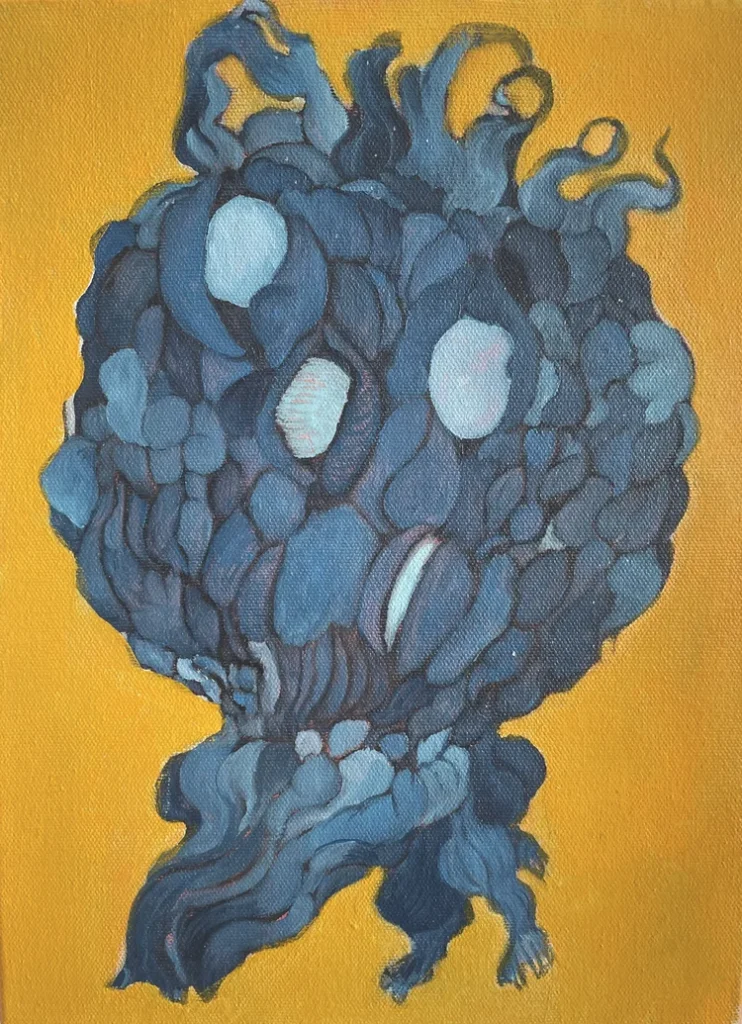
“Estudio semilla brote” (2021) Oil on canvas. 30×23 cm. Copyright Daniela Marten Rothe (2026)
 “Beso” (2022) Oil on canvas. 50×50 cm. Copyright Daniela Marten Rothe (2026)
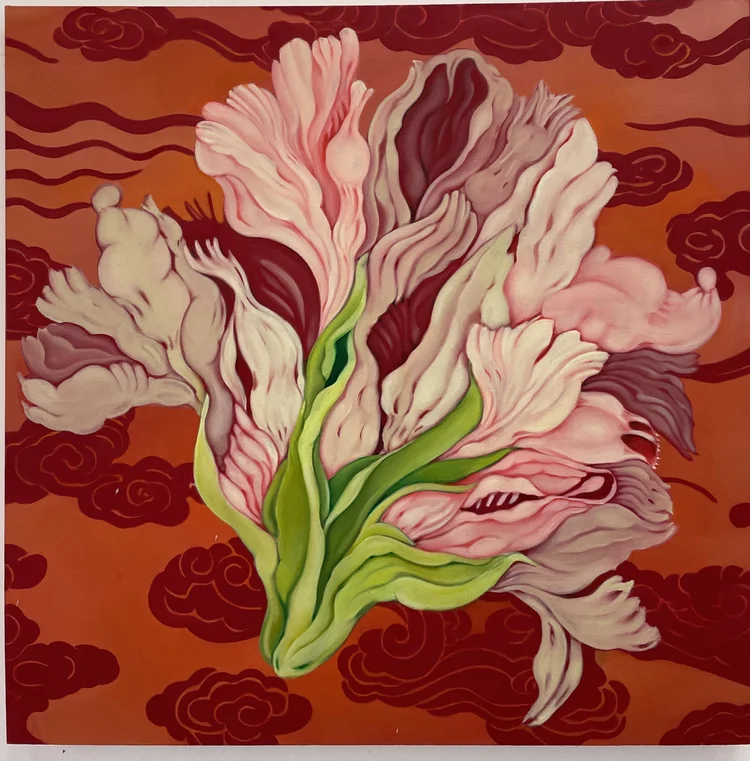 “Feroz” (2022) Oil on canvas. 75×75 cm. Copyright Daniela Marten Rothe (2026)
Daniela’s first kiss was a transaction, but she was in charge. With an innocent intuition she allowed herself to display a playful desire, giving in to an exploration of sensuality without having to pretend to be over sexualized by the male gaze. This is the woman behind an incredibly powerful art collection that celebrates “invented” flowers displaying themselves loud and proud to be erotic, expansive, colorful, sensual, free and not afraid of being seen, being admired, being role models.

Daniela Martén Rother
Artist
Daniela Martén Rothe is a Costa Rican artist who studied Fine Arts at the University of Costa Rica and received independent training with Joaquín Rodríguez del Paso.
She won First Prize at the CROMA Biennial and participated in the 2022 National Salon at the Museo de Arte Costarricense and The Cutting Garden at Room57 Gallery in New York. Her work has also been exhibited at Craig Krull Gallery in Los Angeles, the Centro Cultural de España en Costa Rica, the Centro Cultural Costarricense Norteamericano, the Regional Museum of San Ramón, Klaus Steinmetz Contemporary, Valoarte 2012, and the inaugural exhibition of the feminist collective Casa Ma.
Her practice explores the relationship between nature—particularly flowers—and erotic and creative energy through layered painterly surfaces. Drawing from mythology, religious syncretism, and feminist thought, her paintings imagine new sacred narratives in which the feminine, the tropical landscape, and sensuality become sites of power, transformation, and the divine.

Beatriz Brenes Mora
PubLab Fellow 2026
Beatriz Brenes Mora is an award winning Costa Rican actress, video editor and writer. Her work has been published by Barrelhouse, Michigan Quarterly Review and Iron Horse Review. She’s been a fellow at LARB Publishing Workshop, Tin House Workshop, Anaphora Arts, Macondo Writers Workshop and was a semi-finalist for the Key West Literary Seminar Emerging Writer Award. She holds an MFA in Creative Writing from Pacific University and is currently a PhD candidate at the University of Cincinnati, is the assistant editor of the Cincinnati Romance Review, and where she lives with Matilda, a way-too-smart mini husky with special powers (like her namesake).