
Andrea Long Chu’s Females, Revised
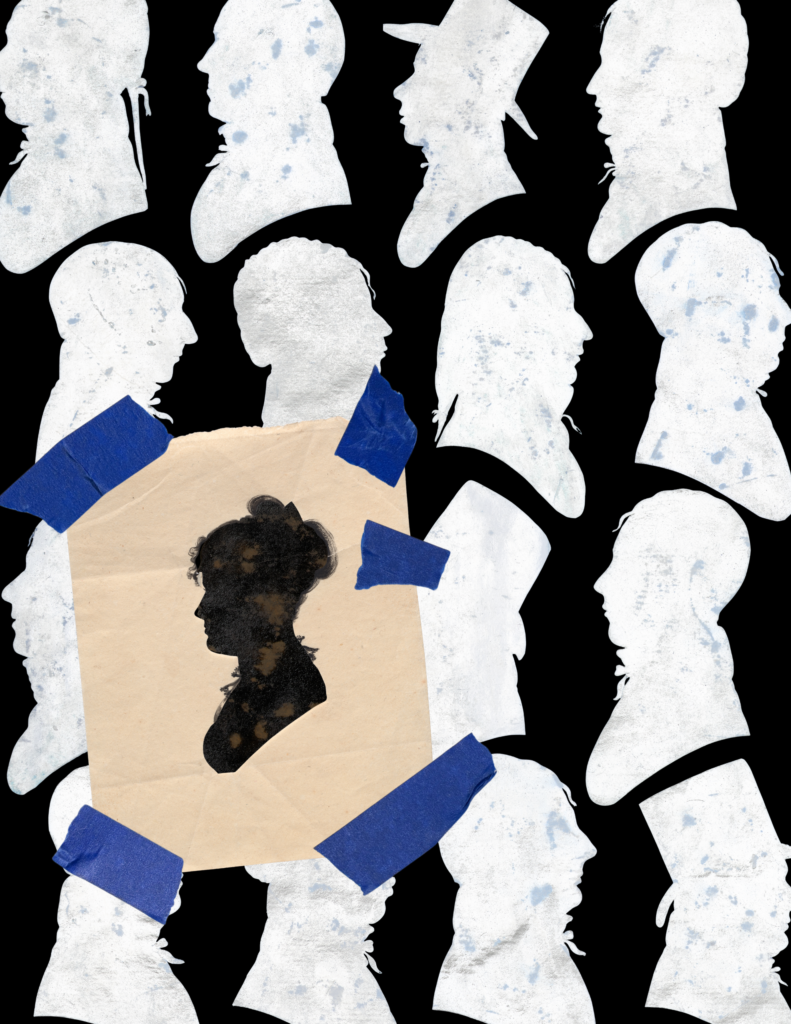
“At Your Own Expense” (2026), digital collage and mixed media, Lauren Burnham. Incorporates various silhouettes from the ledger book of William Bache (1803-12), sourced from the National Portrait Gallery, Smithsonian Institution.
IN THE 2025 reissue of Females, first published in 2019, Andrea Long Chu revises her former self. Chu observes in the newly added afterword that most books published by trans authors, then and now, are memoirs. Empirically, it seems that all marginalized groups in the literary scene must go through a hazing period where publishers mostly accept texts in which the authors explain their identities. Chu says that most of these “read like exercises in carefully solicited prurience, as if their authors think we will be given our rights if we just lift our skirts high enough.” Yet she does not exclude Females from the type of writing she disparages. “It is a short and experimental book, a philosophical tract, a work of psychoanalytic theory, a downtown hagiography, a manifesto for failed artists and by one,” she writes. “[B]ut it is also, if not a memoir, then at least a kind of diary.” In the afterword, Chu contextualizes her earlier claims, acknowledging that she may not have phrased her arguments the same way today.
Trump was president in 2019, when Females was first issued. He was back in office during the book’s reissue, with threats to seek a third term despite it being unconstitutional by the 22nd Amendment. In 2019, even with what little confidence I had in the futures of queer and trans folks, of people of color, I could have never imagined the downturn in the political landscape now. Within the past two years, with the ruling in United States v. Skrmetti, 27 states have passed bans on gender-affirming care for minors. Virginia, where I write from, is the only state in the South where care for trans youths is still precariously allowed. Given that Chu is generally a well-known and well-regarded author—she won the 2023 Pulitzer Prize in Criticism for her writings at New York—the gravitational field she occupies within the queer and trans community is substantial. With so much at stake politically, it matters what one says and how one says it.
The first sentence of Females: “Everyone is female.” Chu develops her ontological claim alongside a close reading of Valerie Solanas’s SCUM Manifesto, interspersing her experience of reading Solanas with quotes from Solanas’s text. The foundation for Solanas’s propositions is that “the male is a biological accident: the Y (male) gene is an incomplete X (female) gene. To be male is to be deficient, emotionally limited.” She then calls for the destruction of the entire male sex. Chu admires Solanas for making sweeping arguments “not because they were accurate or provable, but simply because she wanted to.” Both writers are suspicious of adhering to a political program and would not necessarily consider their work to be feminist. They write in a style “too serious to be taken seriously.”
Like Solanas, Chu subverts normative ideas of sex. She writes, “The thesis of this little book is that femaleness is a universal sex defined by self-negation, against which all politics, even feminist politics, rebels. Put more simply: Everyone is female, and everyone hates it.” Chu defines “female” not to refer to the biological sex, but rather to an ontological condition within the psychoanalytic framework of desire: “To be female is to let someone else do your desiring for you, at your own expense.” Although subjectivity—becoming the subject of desires, responsibilities, beliefs—is valorized as an achievement within the larger symbolic orders of the Freudian Oedipus complex and the Lacanian mirror stage, to be a subject is not actually something people want. In the SCUM Manifesto, Solanas says, “Women […] don’t have penis envy. Men have pussy envy.” Chu’s argument expands on this reaction formation to claim that everyone performs a desire for agency in order to avoid the shame of passivity, a trait associated with feminine identities. “Everyone does their best to want power,” she says, “because deep down, no one wants it at all.”
Put more simply: Everyone is female, and everyone hates it.” Chu defines “female” not to refer to the biological sex, but rather to an ontological condition within the psychoanalytic framework of desire: “To be female is to let someone else do your desiring for you, at your own expense.”
Chu elaborates on the idea that most desires are nonconsensual through describing her life before transitioning medically, when she was an art student first encountering Solanas’s work. She interleaves her readings of the manifesto and Solanas’s play, Up Your Ass, with investigations into other artists and artifacts: the YouTuber Gigi Gorgeous; the comedian and writer Jamie Loftus, who physically ingested David Foster Wallace’s Infinite Jest; The Matrix; the incel subreddit r/TheRedPill; and sissy porn.
Prior to Females, Chu already had a reputation for her provocative writing style from Twitter and her book critiques. A thread from 2019 in the r/asktransgender subreddit asks, “What did Andrea Long Chu do to make other trans commenters hate her?” In the top comment, one user describes her as saying “deliberately provocative things for pretty much it’s [sic] own sake.” Chu has the right to share her own stories in her own words. But given the significant stakes of bodily autonomy and reproductive rights, and given the magnitude of her readership, many of Chu’s critics argue that she has a responsibility to speak thoughtfully.
That tension surfaces in her 2018 New York Times opinion piece, “My New Vagina Won’t Make Me Happy,” where Chu writes, “People transition because they think it will make them feel better. The thing is, this is wrong.” She describes her vagina as a “wound” that will “require regular, painful attention to maintain.” Other writers like Kai Cheng Thom have pointed out that referring to neovaginas as “wounds” perpetuates the trans-exclusionary feminist idea that post-op trans women’s bodies are “fake” versions of cis women’s vaginas. Chu makes the generalized claim that transition won’t make someone feel better. The multiple studies showing the opposite go unmentioned. Her article achieved instant virality, with conservatives, like Erick Erickson and Ben Shapiro, citing it as proof that transness is a mental disorder.
In its premise of subjectivity as a threat and one’s existence as having no escape from being female, the book’s thesis is immensely nihilistic. Escape is futile because trying to do so is proof you’re denying who you really are. Rather than self-expression, gender is a coping mechanism for the process of internalizing the “self’s gentle suicide in the name of someone else’s desires.” From the idea that gender is submission to another’s fantasies, it could then follow that trans women are performing a patriarchal society’s stereotypes of “womanhood,” which is unfortunately the main platform of anti-trans feminists. Chu’s differentiating point is that everyone is objectified, not just trans women.
Chu questions the validity of her critics’ sentiments in the afterword—that her ambivalence in writing about gender and sexuality “would give ‘ammunition’ to those who seek to eliminate us”—saying that those who are anti-trans already possess a surplus of ammunition “in the form of money, institutional support, political networks, and increasingly the law of the land.” However, she concedes that she would not have written the same book today, especially given that her dominant rhetorical strategy of short, provocative aphorism is also the primary rhetorical strategy of the alt-right.
Chu admits that the pessimism in her original text borders on being irresponsible. She contextualizes the pessimism with Afro-pessimism and the queer antisocial thesis, other theories that were popular at the time. The drawbacks of the hard pessimistic stance, she says, are that by making suffering intrinsic to being female, ontologizing it, this mystifies violence and leaves you with no way out of your oppressions. As a possible rationale for her theoretical framing, Chu offers her interiority. Females, she says, was “above all [a book] about my own personal resentments. I felt battered in those days by the omnipresent allegation that simply by getting up in the morning I was denying the truth of my own sex. […] It was not I who was secretly male; it was everyone else who was secretly female.” Her paranoia about not being able to shed all traces of masculinity within herself led her to theorize that masculinity was “itself a form of feminization, rather than a successful defense against it.”
Females is bold, she says, but not always as brave. The poet Paul Tran once told me that one of the most human things you can do is change your mind. The bravest parts of this book are when Chu amends what she says, when she makes visible for the reader the way she worked through and reworked her arguments. Chu revises her thesis away from a total ontological state and toward an ongoing process: rather than saying everyone is female, she says that everyone undergoes a persistent and shifting feminization process. Emphasizing the process provides space for temporal change and historical specificity.
The bravest parts of this book are when Chu amends what she says, when she makes visible for the reader the way she worked through and reworked her arguments. Chu revises her thesis away from a total ontological state and toward an ongoing process: rather than saying everyone is female, she says that everyone undergoes a persistent and shifting feminization process.
Chu ends the afterword stating that her book turned out to be exactly what she wanted to avoid—a sentimental book defending the existence of trans people. To me, though, Females reads as neither sentimental nor as a defense for the trans community. Many of her arguments were used by anti-trans feminists and conservatives as arguments against the right for trans folks to exist. The text’s predominant mood was one of self-loathing. I had the sense that everyone reading the text should be as unconditionally self-hating as the narrator. It wasn’t until the last few pages of the reissued version—when Chu confesses her own experiences of gender paranoia and biological transition—that I could see a reader describing her writing as “sentimental.” If Chu’s main intention was to emphasize the totalizing aspect of her thesis, it makes sense that she would withhold more of her personal motivations. And as a writer who belongs to historically marginalized populations, I deeply understand the desire not to want to explain myself.
I think often about an interview between Summer Farah and Fargo Nissim Tbakhi at The Poetry Project, where Fargo said, “My work is for Palestinians, those who love us, and the people that we love.” I wonder if Chu has an ideal audience she writes to. For a queer reader, a trans reader, a reader whose interiority is so much oriented around the desires of becoming someone or something else, what are we to do with the idea that what we really want to become is just “a canvas for someone else’s fantasy”? How are we to be in dialogue with another? How are we to live?
Chu would hate that the lines I need most are the very ones she wants the marginalized writer to be free from writing. “A trans person is not a person whose gender does not ‘match’ their sex,” she says. “A trans person is quite simply a person who transitions. It is a thing one does, not a thing one is.” Could it be true then, that we are all trans, that we are all beings in flux all the time, choosing to change, and that maybe, even if for an instant, we might not hate it?
Holly Zhou
Publab Fellow 2026
Holly Zhou is a writer and mixed-media artist from the California desert, the unceded territory of the Cahuilla and Mojave peoples. Holly’s poetry and prose have appeared in The Kenyon Review, Michigan Quarterly Review, Seventh Wave, and elsewhere. When not writing, they can be found exploring rocks by the ocean or in the mountains.
Lauren Burnham
Publab Fellow 2026
Lauren Burnham is an editor and amateur digital collagist who currently works in a library crafting book displays and designing literary crafts for kids.