
Do You Know Where Your Kids Are?
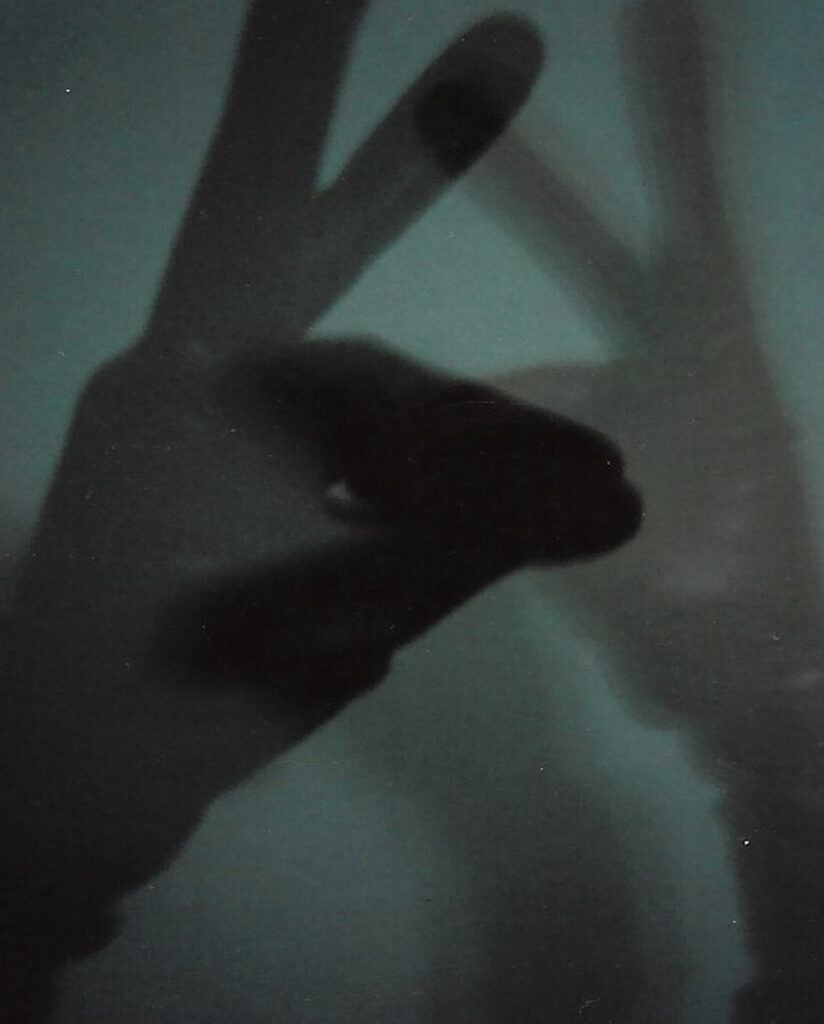
“Shadow Hunt” (2026), Tanya L. Young. Courtesy of the artist.
There were maybe three reasons this might not work. First, he hadn’t been fasting like each book strictly recommended. That day, Jason had a large breakfast and lunch, all without any worry. Second, it wasn’t midnight. It was three in the afternoon, the sun was out after a morning of heavy rain, and everyone was either at work or indoors. And third, the black cat wasn’t alive when he boiled it, mostly whole, in the heavy red stockpot, on the front burner of his mother’s stove. Thinking harder, he realized a fourth reason: no one, in any of the books he had read at the library, ever knew which boiled black cat bone to put in their mouth. He knew all of this but tried anyway.
Jason wanted to become invisible, intangible, or “totally free,” he had told himself. That afternoon, as he walked down the gravel alley that snaked behind the tight-knit homes, he could feel this ancient spell’s opportunities all around him, but they hovered at his fingertips just out of reach. On these walks, he would often picture himself slipping in and out of closets, doorways, windows, and bank vaults like an unseeable mist. In these fantasies, the boy spied on his neighbors while they slept, walked through traffic, and maybe, just maybe, ran away from home completely, totally out of sight, in broad daylight. His mind swam as he pondered the limitless possibilities of an invisible boy.
At 12 years old, Jason walked this same alley almost every day to get home from school. With his parents either working or entangled in social obligations, these hours of unique solitude had, by that point, become innumerable. But today, instead of seeing trash bins neatly pushed back, he saw a circle of crows, their cackles echoing as they attended to something on the ground. They were rowdy, jerking their feathered heads back, beaks pecking at a black cat that laid outstretched next to a deep, waterlogged pothole. Clusters of fur and sinew sat like confetti on the damp gravel, thrown here and there by one particular crow. It was this very crow Jason had to fend off to pick up the cat, sticky from the attack. It was also this crow that followed him home, Jason’s arms tightly wrapped around the carcass inside his all-blue raincoat, as the flurry of frustrated birds dissipated behind him.
This opportunity had presented itself, he thought, at the perfect time, and he wasn’t about to miss it. Ever since he read the Spell of Invisibility, he had been waiting for a pure black cat to come into his life. He had repeatedly asked his mother for one on birthdays, Christmases, and even the occasional Easter. But every time he asked, she would simply shake her head and remind him in that distant voice he knew well: “You can’t keep your room clean, how could you care for a pet?” Normally, he would then nod softly and let it go for the time being, but today, he didn’t have to do any asking. Everything he wanted was right in front of him. And so, he entered the kitchen and placed the cat’s body on a counter near the stove.
Outside, the lone crow had made itself comfortable against the lip of a windowsill planter, clattering and digging its beak into the rain-softened soil. Occasionally, it would pull out a rock or clod of dirt and drop it, then resume its squawking. Despite the nuisance, Jason hauled out the heavy stockpot his mother kept in the lowest cabinet. He filled it with water and lifted it with extreme effort, hoisting it onto the top of his mother’s gas range stove with a massive clamor. While the water was still cool to the touch, he dropped in the dead cat, then turned up the heat and waited. The crow began to knock its face into the glass in succinct, hefty slaps. While the water boiled, the cat’s flesh removed itself from the bones in a lazy drift, like kelp divorcing the shore at rising tide.
This was when he became concerned. There were so many parts of the plan that weren’t right. He had eaten twice, it wasn’t night at all, the cat was dead, and he still didn’t know how to find the right bone out of the 230 he would soon have, overflowing like treasure. But more than any of that, what sent his mind racing toward panic was the stench and steam billowing from the pot and beginning to fill the room. He felt sick. It was then that he decided to take the still hot and not fully clean bones out to a table on the deck.
The crow was now thrashing against the window in aggressive thrusts of flight, abandoning its post on the planter as Jason rushed from the door and out onto the deck. In deep swoops, the bird lunged at what Jason held in his hands. Protectively, Jason placed the steaming mess on the tabletop and feverishly picked the leftover tissue from the bones. After what felt to him like hours, he had finally counted out exactly 230 bones, all ranging in size and fragility, and began the task of placing them in his mouth and chewing. The entire time, the lone crow squawked from a far corner of the table, simply watching.
Jason worked slowly over the stack of bones, putting them one by one into his mouth. But with each thin rib or jagged vertebra, his dread worsened. None of these bones worked. He had once read about someone that was able to do it by putting all 230 in their mouth, in different handfuls. He had also read that each black cat had its own unique invisibility bone—it was never the same bone from one cat to the next. The spell’s variability crashed around his ears like an avalanche. In his desperation, they were his only beacon of hope. So, with spit seeping from his overcrammed lips, he pushed bones into his mouth at a quickening pace, hoping that if he put in enough, or the right one by accident, he would become invisible.
It was then that the bird made its way closer and closer to the drooling boy and his pile of bones. The bird wanted what he had: that stench from the kitchen that still clung to each of the bones on the table and in Jason’s mouth. The bird took up three small bones in its beak and proceeded to drop them onto the wooden deck. With a flush of fear, Jason dropped to his knees, hands outstretched, mouth still full, searching for the scattered bones. Once he was able to finger them out from a space between the deck slats, he placed them into his bulging mouth. Foam frothed at the corners of his lips and his chin quivered.
The bird soon picked up more bones, picking at bones that Jason hadn’t even had a chance to chew. He attempted to scare the bird away by furiously waving one hand, as he shoved new combinations of skeletal remains into his mouth with the other hand. Sweat poured from his
forehead and palms, his heart beating heavily behind his ribs like a bell. Jason knew he was getting close. He could feel it. He would find exactly what he needed, he was sure. Then, he would be gone. He would become invisible and free from sight; then he could do anything he
wanted.
Finally, Jason was faced with one last pile of bones to chew. As he continued the reckless gnawing, the bird took up its squawking once again. It was now swooping around his head and the bones on the table. With quickening pace and spittle rushing a torrent down his chin, Jason kept trying bones, all while the bird kept lunging down with hungry ferocity. The bird landed, again, at the corner of the table, adjacent to the final stack of bones. Jason’s mouth bled from the sharp edges of bone after bone, shard after shard. With each gnash, he fought the feeling of his opportunity slipping away. With each sound he heard from the street and alleyways, which at any moment threatened to be his parents, his determination built into a frenzy. Jason’s mind flashed with his desires, an open window, an unseen boy creeping to the foot of a bed, his hands dipping into a river with no reflection looking back at him. He wanted the whole world to open itself to him like a yawn and he would be the invisible breath passing through.
There were only five bones left when he looked up, jarred to awareness by a swift clatter of wings as the bird juggled, in its beak, one delicate rib bone. As it tilted its slick, feathered head back, Jason gasped, frozen in place. In an instant, the bird disappeared the bone into its gape. As the bone slid deep into its beak and down its throat, the bird, perched in place on that wooden tabletop, began to vanish from sight completely.
Tanya L Young
Tanya L. Young is a BIPOC writer, visual artist, and PhD student. Her work is featured in publications such as New Delta Review, Salt Hill Journal, The Amistad, New York Quarterly, and others. She is a VONA alum. She was the 2022-2023 Poetry Editor for Bellingham Review. Currently, she serves on the Editorial Committee for The Ocean State Review. She is also a reader for TriQuarterly.
Find more of her work at www.tanyasroom.com and follow her on instagram @wheelofashes.