
Self-improvement
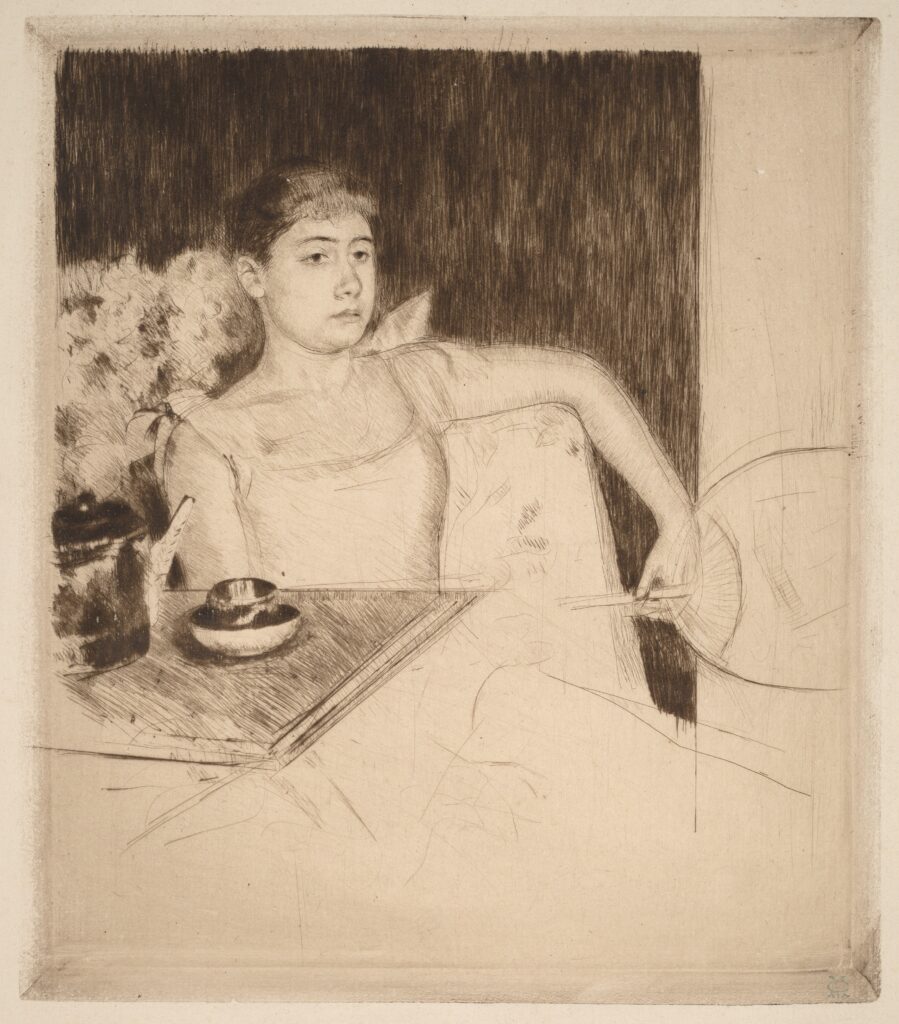
“Tea” (c. 1890), Mary Cassatt. Courtesy of the National Gallery of Art.
It was one of those clear, sunny October days: crisp, bright mornings; intense, red afternoons; chilly, slow evenings. It was Sunday, so at 5 p.m. she went to yoga class. That was the best way to wrap up the week and start the new one on the right foot. Yes, that’s what she had written on her vision board on Friday night while waiting for her rooibos tea to brew.
Cozily, she sat on the couch wearing her lounge clothes, the pink fleece throw blanket on her lap. On the windowsill to her left, candle lights were neatly arranged next to propagation cups displayed in sets of two: two monsteras; a contraption made from an avocado seed and three toothpicks, half-submerged in water; and a succulent. Each cup, a former star in an Instagram story, was a subtle statement of the kind of person she was. Friday evenings were for self-care, so she could work on her self-improvement routine before the week was officially over. Sure, she could have done it on Saturday morning, but then it would have been during the weekend. The weekend was for being active. The planning had to be done on Friday night, because on Saturday morning she would get up, put on her gym clothes, and go for her weekend run. She ran every Saturday morning before 11 a.m. because afterwards she liked to stop at the café on the corner of 4th and Main Street and have a cappuccino.
Two years ago, while on a trip to Rome, she learned that cappuccinos are not served after 11 a.m. in Italy, so she stopped drinking cappuccinos after 11. To do so would have been cultural appropriation. She once saw a YouTube video where they explained that wearing huaraches would be cultural appropriation, so now she was careful to be culturally respectful. The following week, she donated the huaraches she had bought during her vacation in Mexico to Goodwill and started drinking black coffee whenever she finished her morning run after 11. She was working her way toward becoming a matcha latte drinker, but she was not quite there yet. She found the taste of matcha too strong.
Her trip to Italy had been transformative. That’s the word she used whenever someone asked her how the trip had gone. Most people would instinctively say “good for you” or “amazing” or “awesome!” Usually, they were waiting for their turn to recount their own experiences from their trip to Bali or Goa, and how life-changing those had been for them too. They’d talk about how they would leverage their travel experience to finally launch their business, build community, or simply become better people.
What she really meant by transformative, however, was that she had arrived in Rome hopeful and full of that expectant energy of the young, naive traveler, only to leave the country broke, sick, and depressed.
After traveling for almost 24 hours, switching planes in random cities, and catching the last red-eye to Rome to get the cheapest deal, she discovered that she had misplaced her phone. Exhausted and lost, she dragged her luggage across the cobblestone streets for an hour before she finally reached her hostel. She wished she had packed a carry-on suitcase instead of her matching duffel bags. She wished she had stayed home.
Later that day, in the crowded, musty, six-bed room where she was staying, she fantasized about her adventure and how she’d have a great time despite her initial misfortune. She fantasized about meeting a beautiful Italian man who would invite her to dinner at a restaurant unknown to tourists (it was his uncle’s!), where they would eat a delicious risotto paired with the most unpretentious glass of white wine—local, of course. They would have had the most wonderful time talking about books, art, life stories—the topics that mattered. He would speak English perfectly, which he had learned by watching foreign movies. They would get along so well. Maybe he would even visit her back home, and she would get to show him around, take him to that nice brewery downtown. But she decided not to explore that far into her fantasy; she didn’t want to jinx it. Lying in her uncomfortable bed, she felt a fever creeping in and took an aspirin around midnight.
The snoring coming from the top bed, the smell of the damp towel hanging just a few inches from her nose, the sweat that would turn cold and make her shiver all night—that was what she would later think of when reminiscing about her trip to Italy.
She sweated the fever out for a few days. The morning of day two, she vomited the crackers she had forced herself to eat. On day three, she started feeling better, although she still felt weak. At around 11 a.m. that day, the kind Moroccan front desk guy, who had given her a set of clean sheets at check-in, helped her figure out her way to the nearest grocery store. When she arrived, she grabbed a basket and filled it with a couple of bananas, some rice, chicken, and tea. At the register, feeling increasingly pressured by the impatient cashier (who mumbled in Italian), she looked for her wallet but couldn’t find it. She went back into the store, returned all the items she had previously and intently picked to their corresponding aisles, and grabbed a Maruchan instant noodle soup. She paid 1.99 euros with the 2-euro coin she found in her backpack and left the grocery store. Back at the hostel, she confirmed her passport was still in the safe, but her wallet had disappeared. She couldn’t remember where she had left it. Then, she went to the tiny kitchen and boiled water in a rusty kettle. She stood in silence, listening to the sound of the water coming to a boil—slow and predictable, a stark contrast to the animated conversations in broken English, Spanish, Italian, and German coming from the common area. They were talking about people they’d met, parties they’d attended, museums they’d visited, invitations they’d gotten, the lives they’d lived. While she waited the four minutes it took for the water to boil, she noticed she had gone to the grocery store wearing her pajama pants, and a hollow feeling filled her chest. She would later identify that same numbing emptiness a few years later and describe it as loneliness. But not then.
She spent the remaining two days wandering around the city. If she had stayed until Sunday, she could have visited one of the museums on her list, which was free on Saturdays until 2 p.m., but her flight back home departed on Saturday at 10 a.m. She lived off the 50-euro bill her mom had given her that she had kept separately in her backpack.
At 3 p.m. on her last day, she went to a nice-looking café next to the Colosseum to treat herself to a cappuccino, only to find out about the 11 a.m. cappuccino curfew. As the waiter impatiently suggested some other options from the menu, her eyes filled with water. It wasn’t one of those crying fits one feels coming, slowly yet predictably growing in their throat until it explodes into an uncontrollable sob. No. The tears were simply already there, descending her cheeks, down to her neck, until they finally landed on her soon-to-be-soaked scarf.
Later that day, in the crowded, musty, six-bed room where she was staying, she fantasized about her adventure and how she’d have a great time despite her initial misfortune.
At her yoga class, the instructor invited her to turn inward and let go of what no longer served her. She tried to be in the moment, but kept getting distracted by the moving trees outside. It was not a windy day, but the tall branches moved back and forth, dispersing the late afternoon light into the studio and casting sad little patches of patterned figures. Child’s pose. The small class stretched in sync, closing out the weekend, getting ready for the new week. Shavasana. She relaxed into the pose, slowly drifting off into that half-awake, half-asleep limbo, feeling the warmth of the last rays of sunlight until a soft bell rang. The class had ended.
Her classmates sighed, stretched, smiled, slowly stood up, and then put their mats away. “Thank you for such a wonderful class. Namaste, see you next week,” the students said, while they softly hugged the instructor and then left, the bright light flashing and lighting up their content faces as they unlocked their phone screens.
Walking outside, she grabbed her phone, flipped the camera into selfie mode, and tidied up her hair with her free hand. She looked good, she thought. In the background, the curvy om symbol sat below the yoga studio sign on the left corner, the tree silhouettes in the back, dark and fading, her face, uncentered, showing an unassuming smile. Click.
She would later edit the photo, the brightness, the contrast. She would wait a couple of hours to post it. She didn’t want to seem too eager. She had perfected that balance throughout the years. That threshold between the subtle yet confident presence and the cool, standoffish busyness with life. She started like everyone else, assessing the number of likes she got to calibrate her performance, steadily fine-tuning how much, how cryptically, or how revealingly she would post. She obsessed over her likes so much that it was now second nature.
At home, she heated up her dinner on the stove. Everything was as it should be, yet she felt restless. Another week had gone by. A new one was about to start: it was busy, perfectly organized to juggle all her social, creative, and wellness activities around her work schedule, as always. Therapy was on Mondays, dinner with her girlfriends on Tuesdays, a movie or show on Wednesdays, art class on Thursdays, and self-care on Fridays. It wasn’t that she was unhappy; she was not. It wasn’t that she felt unfulfilled; she did not. It was an alienating emptiness that would creep in every once in a while. The lump in her throat was barely noticeable, and she was used to the continuous loop of thoughts rummaging through her mind. Every Monday, she would start by telling her therapist about her dreams: how she kept getting lost, how she kept missing trains and planes, how she kept running late to tests and meetings.
She finished dinner and did the dishes after putting away the pots and glasses that had been drying on the rack since morning. It was still too early to go to bed, so she sat on the couch and observed the darkness outside the window. It was a crescent moon—a perfect sliver of whiteness hanging low in the sky, suspended in between passing tatters of cloud.
She could hear footsteps on the top floor, the rush of the end-of-day shenanigans coming from the young family who lived upstairs. She knew the sounds would soon turn into the distant muttering of the television: a movie, a show, the odd burst of laughter.
She got up and paced around the apartment, taking in the darkness of the empty rooms, briefly illuminated by the green blinking lights of the alarm clock and the charging toothbrush. Every now and then, notifications would light up her phone screen.
She stood at the entrance of her bedroom for a few minutes, until she finally grabbed her phone from the nightstand, went back to the living room, and lay down back on the couch.
She scrolled on her phone for a few minutes, then opened the selfie she had taken earlier. She stared at it for a while and then posted it; the restlessness started fading away, slowly turning into something else.
Ana Oliveira
Publab Fellow 2026
Ana Oliveira is an emerging writer whose literary short fiction explores daily life, domesticity, and family dynamics as a way of investigating the complexities of being human. Born in Portugal, she now lives in Davis, California, where she works as a STEM researcher.